Date & time
Working days in Poland in 2026 and 2027: deadlines and working hours
Poland has 253 working days in 2026, but the statutory working time is 2,008 hours, which is 251 days of 8 hours. This guide explains the gap, how to count deadlines in days and in working days, and what happens when a deadline ends on a Saturday or a public holiday.
- HNarzędzia editorial team
- Published:
Two numbers get mixed up in Poland: the count of working days and the working time in hours. A working day is a weekday that is not a public holiday. The working time in hours is reduced further by every public holiday that falls on a Saturday, because the employee gets a different day off in exchange. Two holidays fall on a Saturday in 2026, so the year has 253 working days but 251 days of work. If you run payroll or schedules for a Polish employer, or you work for one, you will meet both numbers.
Working days and hours in every month
The values below come from the “Year calendar” mode of the Working days calculator, checked against a separate calculation in Node. The hours are for a full-time employee (8 hours a day) with a one-month settlement period.
| Month | 2026: working days | 2026: hours | 2027: working days | 2027: hours |
|---|---|---|---|---|
| January | 20 | 160 | 19 | 152 |
| February | 20 | 160 | 20 | 160 |
| March | 22 | 176 | 22 | 176 |
| April | 21 | 168 | 22 | 176 |
| May | 20 | 160 | 19 | 144 |
| June | 21 | 168 | 22 | 176 |
| July | 23 | 184 | 22 | 176 |
| August | 21 | 160 | 22 | 176 |
| September | 22 | 176 | 22 | 176 |
| October | 22 | 176 | 21 | 168 |
| November | 20 | 160 | 20 | 160 |
| December | 21 | 160 | 22 | 168 |
| Total | 253 | 2,008 | 253 | 2,008 |
In four months the hours are not 8 times the working days: August and December 2026, and May and December 2027. Each of them has one public holiday on a Saturday. August 2026 has 21 working days but only 160 hours, which is 20 days of work. The calculator shows the same split in its “Saturday holidays” and “Days of work” columns.
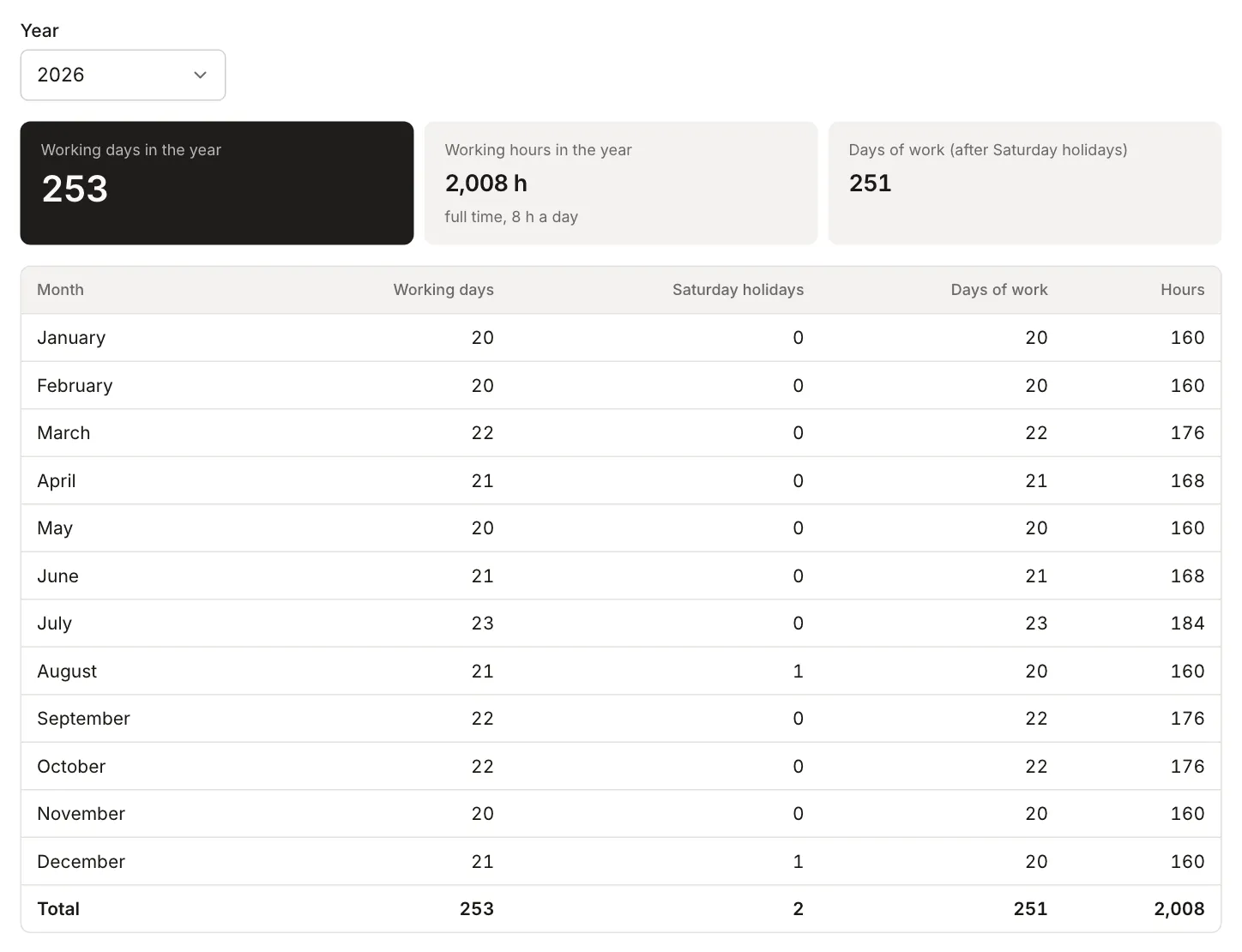
Working time is set by Art. 130 of the Labour Code (consolidated text: Journal of Laws 2026, item 1245, checked in October 2026). Paragraph 1 multiplies 40 hours by the number of full weeks in the settlement period and adds 8 hours for each remaining day from Monday to Friday. Paragraph 2 says every holiday in the settlement period that falls on any day other than Sunday reduces the working time by 8 hours. For a single month this equals 8 hours times the number of Monday-to-Friday days, minus 8 hours for each holiday that is not on a Sunday.
Public holidays in 2026 and 2027
The list comes from Art. 1 of the Act of 18 January 1951 on days off from work (consolidated text: Journal of Laws 2025, item 296, checked in October 2026). Since 1 February 2025, 24 December (Christmas Eve) is a day off as well. It was added by the Act of 6 December 2024 (Journal of Laws, item 1965). The calculator treats Christmas Eve as a holiday from 2025 on.
| Holiday | 2026 | 2027 |
|---|---|---|
| New Year’s Day | 1 Jan, Thursday | 1 Jan, Friday |
| Epiphany | 6 Jan, Tuesday | 6 Jan, Wednesday |
| Easter Sunday | 5 Apr, Sunday | 28 Mar, Sunday |
| Easter Monday | 6 Apr, Monday | 29 Mar, Monday |
| Labour Day | 1 May, Friday | 1 May, Saturday |
| Constitution Day | 3 May, Sunday | 3 May, Monday |
| Pentecost Sunday | 24 May, Sunday | 16 May, Sunday |
| Corpus Christi | 4 Jun, Thursday | 27 May, Thursday |
| Assumption Day | 15 Aug, Saturday | 15 Aug, Sunday |
| All Saints’ Day | 1 Nov, Sunday | 1 Nov, Monday |
| Independence Day | 11 Nov, Wednesday | 11 Nov, Thursday |
| Christmas Eve | 24 Dec, Thursday | 24 Dec, Friday |
| Christmas Day | 25 Dec, Friday | 25 Dec, Saturday |
| Second Day of Christmas | 26 Dec, Saturday | 26 Dec, Sunday |
Easter, Pentecost and Corpus Christi move with the church calendar. The calculator and our separate calculation gave the same dates for both years.
A holiday on a Saturday: a day off in exchange
In 2026 the Saturday holidays are 15 August and 26 December. In 2027 they are 1 May and 25 December. Art. 130 § 2 reduces working time by 8 hours for every holiday except those on Sunday, so a Saturday holiday reduces it too. An employee on a five-day week does not work on Saturday anyway, so the employer has to give another day off. The Polish National Labour Inspectorate (PIP) describes it this way: see the regional inspectorate in Katowice on August 2026 (31 July 2026) and PIP on the day off for 15 August (12 August 2026). Both were checked in October 2026 and are in Polish.
From those pages:
- the day off must fall in the same settlement period as the holiday, before or after it, so within the same month if the period is one month,
- the employer picks the day; an employee’s request for a particular day, such as 14 August, does not bind the employer,
- a holiday on a Sunday does not reduce working time and gives no extra day off, so 3 May, 24 May and 1 November 2026 do not change the hours,
- the rule applies to employees for whom Saturday is a day off under an average five-day working week; people who work on Saturdays, some part-time staff and employees on an equivalent working-time system are treated differently.
For August 2026 PIP gives 160 hours, or 20 days of work, which is the same figure the Working days calculator shows. The Labour Code covers employees only. People on a civil-law contract (zlecenie or o dzieło) are not covered by it.
The calculator assumes full time and a one-month settlement period. It does not subtract excused absences (Art. 130 § 3), part-time work, shift schedules or extra days off set by your company. For an unusual schedule, treat the table as a reference and calculate working time under your workplace rules.
Deadlines in days and in working days
When a statute or contract gives a deadline in days with no further rules, the Civil Code (consolidated text: Journal of Laws 2026, item 795, checked in October 2026) applies through Art. 111 and 112. A deadline in days ends with the last day, and the day of the triggering event (for example delivery) is not counted. A deadline in weeks, months or years ends on the day with the same name or date, or on the last day of the month if the final month has no such date. All of these are calendar days, so Saturdays, Sundays and holidays count.
“Working days” appear only when the contract or the rule says so. Check how that contract or rule defines them. The tools on this site treat a working day as Monday to Friday excluding statutory holidays, and Saturday is not a working day.
The difference shows in five examples calculated with three tools. We entered the dates by hand and fixed “today” in the browser to 12 October 2026, so the default field values were the same on every run. All results matched the calculation in Node.
| Question | Tool | Result |
|---|---|---|
| 14 days from 11 December 2026 | Add days to date | 25 December 2026, Friday, Christmas Day |
| 14 working days from 11 December 2026 | Working days calculator, “Add working days” mode | 5 January 2027, Tuesday |
| 10 working days from 1 April 2026 | Working days calculator | 16 April 2026, Thursday (Easter Monday is skipped) |
| 30 days from 16 July 2026 | Add days to date | 15 August 2026, Saturday, Assumption Day |
| 14 days from 9 September 2026 | Add days to date | 23 September 2026, Wednesday, a working day |
Add days to date does not count the start day, in line with Art. 111 § 2 of the Civil Code, and its “Type of day” field says whether the result is a working day, a weekend or a holiday. The “Add working days” mode does not count the start day either. From 11 December 2026, 14 calendar days and 14 working days end 11 days apart, because the holidays and weekends in between do not count as working days.
Also check whether both ends of the range are counted. Days between dates shows 11 days and 9 working days for 3-14 August 2026 by default, because it leaves out the end date. With “Include the end date” turned on, the result is 12 days and 10 working days. The Working days calculator in “Between dates” mode counts both dates and gives 10 working days and 80 hours for the same range. If the numbers differ, look at whether the end day is included.
A deadline ending on a Saturday or a holiday: Art. 115 Civil Code
Art. 115 of the Civil Code says that if the end of a deadline for performing an act falls on a statutory day off or on a Saturday, the deadline ends on the next day that is neither a day off nor a Saturday. Sundays are statutory days off too (Art. 1 point 2 of the Act on days off from work), so the shift covers the whole run of free days.
Two examples from the table above:
- The 14-day deadline from 11 December 2026 ends on 25 December (a Friday and a holiday). 26 December is a Saturday and a holiday, and 27 December is a Sunday, so the deadline ends on Monday, 28 December 2026.
- The 30-day deadline from 16 July 2026 ends on 15 August (a Saturday and a holiday). It ends on Monday, 17 August 2026.
None of these tools moves the result for you. They show that the date falls on a weekend or a holiday, and you find the next day that is not a holiday or a Saturday yourself, for example by adding one more day and checking its type.
Art. 115 applies to deadlines counted under the Civil Code. Other laws have their own rules or refer back to civil law:
- in civil proceedings, Art. 165 § 1 of the Code of Civil Procedure refers to civil-law rules (consolidated text: Journal of Laws 2026, item 468),
- for taxes, Art. 12 § 5 of the Tax Ordinance has its own rule: if the last day of a deadline falls on a Saturday or a statutory day off, the deadline moves to the day after the free days, unless a tax act provides otherwise (consolidated text: Journal of Laws 2026, item 622).
In employment law the Civil Code applies only where labour law has no rule of its own (Art. 300 of the Labour Code). Whether Art. 115 covers other kinds of deadlines, such as a notice period, limitation periods or a deadline set in a contract, depends on the provisions and on case law. A calculator cannot settle that. For deadlines that affect rights or money, check the provision that creates the deadline or ask a lawyer. This guide is general information and not legal advice.
Long weekends and bridge days in 2026
For 2026 the Long weekends tool lists three periods off without taking leave:
| Period | Days off | Holidays |
|---|---|---|
| 4-6 April 2026 | 3 | Easter Sunday, Easter Monday |
| 1-3 May 2026 | 3 | Labour Day, Constitution Day |
| 24-27 December 2026 | 4 | Christmas Eve and both days of Christmas |
The last period includes Saturday, 26 December. That is a holiday on a Saturday, so the employer must give a separate day off for it within the settlement period (in December for a monthly period). The employer chooses which day.
A bridge is a day of leave between a holiday and a weekend. These are some of the best-value options in 2026 (figures from the tool at its default limit of 5 leave days per bridge, also checked with our own calculation):
| Period | Days off | Leave days | Days to take |
|---|---|---|---|
| 1-4 January | 4 | 1 | Friday, 2 January |
| 3-6 January | 4 | 1 | Monday, 5 January |
| 1-6 January | 6 | 2 | 2 and 5 January |
| 4-7 June | 4 | 1 | Friday, 5 June (after Corpus Christi) |
| 7-11 November | 5 | 2 | 9 and 10 November |
| 7-15 November | 9 | 4 | 9, 10, 12 and 13 November |
| 19-27 December | 9 | 3 | 21, 22 and 23 December |
| 24 December 2026 - 3 January 2027 | 11 | 4 | 28, 29, 30 and 31 December |
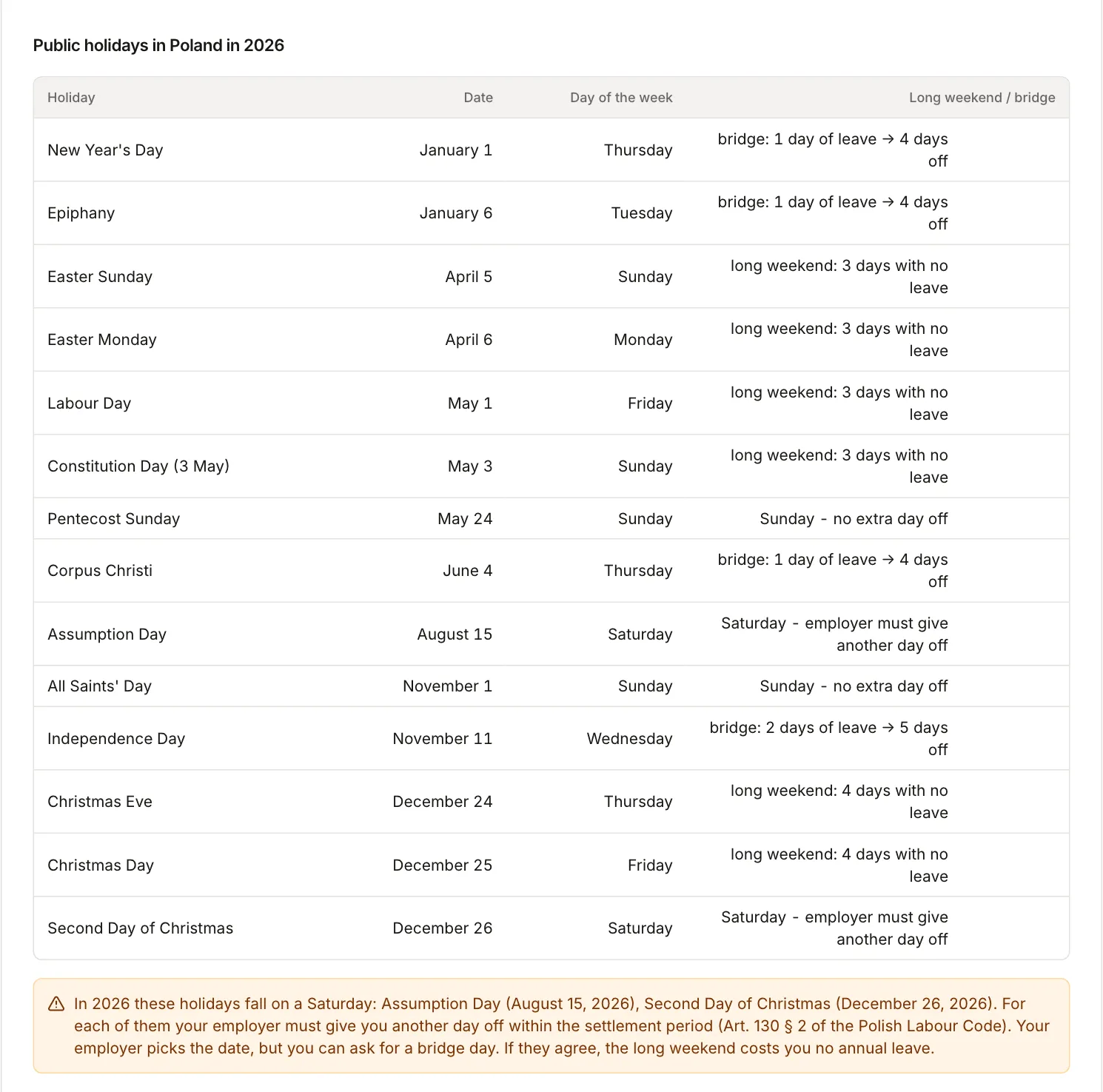
A Saturday holiday changes the arithmetic. Assumption Day is on Saturday, 15 August 2026. If the employer sets Friday, 14 August as the day off, you are off from Friday to Sunday without using annual leave. You can ask for it, but the employer decides, so do not book travel before you have confirmation.
The “Days off in a row I want” field in the same tool tells you how much leave a given stretch needs. For 9 days in 2026 the answer is 3 days of leave (19-27 December). To see how much leave you are entitled to in the first place, use the Annual leave calculator.
When not to rely on the tables
The tables in this guide and in the tools rest on the statutory list of 14 days off from work, plus Saturdays and Sundays. They leave out extra days off in a company, shift schedules, part-time work and an employee’s absences. The holiday list in the calculator matches the Act as checked in October 2026. If the law changes, compare the dates with the current text of the Act. For legal deadlines, the provision you rely on decides, not the calculator’s result.