Law & business
Statutory late payment interest in Poland: how to calculate it and when commercial interest applies
If you invoiced a Polish company and it paid late, you may be owed interest at 13.75% a year, but a Polish individual who pays late owes 9.25%. This guide explains which rate applies, which day interest starts, what happens when the National Bank of Poland changes its rate during the delay, and when the fixed euro compensation is added.
- HNarzędzia editorial team
- Published:
Polish law has two sets of late payment rates. Interest under the Civil Code (the Polish abbreviation is KC, for Kodeks cywilny) is the default for any debt. A separate Act of 8 March 2013 on preventing excessive delays in commercial transactions sets higher rates for business-to-business invoices. The late payment interest calculator handles both, but you choose the type and enter the correct due date. This guide covers where those inputs come from. Rates and legislation were checked in October 2026, and the sources are listed at the end. The guide assumes the contract is governed by Polish law.
Which type of interest applies
The calculator offers four types:
| Type | Legal basis | Formula | Rate from 5 March 2026 |
|---|---|---|---|
| Late payment (statutory) | Art. 481 § 2 Civil Code | NBP reference rate + 5.5 pp | 9.25% |
| Commercial (late payment in commercial transactions) | Art. 4 point 3(b) of the 2013 Act | NBP reference rate on 1 January or 1 July + 10 pp | 14% in H1 2026, 13.75% in H2 |
| Commercial, debtor is a public healthcare entity | Art. 4 point 3(a) of the 2013 Act | same, but + 8 pp | 12% in H1, 11.75% in H2 |
| Capital | Art. 359 § 2 Civil Code | NBP reference rate + 3.5 pp | 7.25% |
NBP is the National Bank of Poland, and “pp” means percentage points. Capital interest is not a penalty for lateness. It is payment for using someone else’s money, for example under a loan with no agreed interest, so it normally does not apply to an overdue invoice.
For ordinary late payment the Civil Code rate applies. In a commercial transaction the Act replaces it (Art. 4a of the Act). A commercial transaction is a contract for paid supply of goods or services concluded in the course of business, and the only parties can be businesses or other entities listed in Art. 2 of the Act: for example public bodies, members of liberal professions and businesses from EU and EFTA states and Switzerland. An invoice to a consumer is not a commercial transaction, so only the Civil Code rate applies.
Two points matter for a foreign supplier. First, the Act names businesses from the EU, the EFTA states and Switzerland. Whether it covers a business from another country, such as the United Kingdom or the United States, depends on the contract and the governing law, so ask a Polish lawyer before you rely on it. Second, if the contract chooses foreign law, the Civil Code still says that its rules on maximum late payment interest cannot be excluded or limited that way (Art. 481 § 2³).
The Act also sets conditions. The creditor must have performed and not been paid by the contractual deadline, and interest is then due without any demand (Art. 7(1) for debtors other than public bodies, Art. 8(1) for public ones). Parties can agree a higher rate than the statutory one. The calculator only knows statutory rates, so a contractual rate has to be calculated separately. The Act does not apply, among other things, to debts covered by insolvency or restructuring proceedings from the moment they start, or to contracts between public-finance entities only (Art. 3).
The Act implements the EU Late Payment Directive (2011/7/EU). The directive sets a floor of the reference rate + 8 pp and a fixed EUR 40 compensation. Poland’s rate is higher, at + 10 pp, and its compensation scales with the amount.
Where the rates come from
Both rates start from the NBP reference rate, which the Monetary Policy Council sets. They differ in when a change of that rate carries over to interest:
- Civil Code interest changes together with the reference rate. The Minister of Justice announces it in the official gazette Monitor Polski (Art. 481 § 2⁴).
- Commercial interest stays fixed for a half-year. For interest from 1 January to 30 June the reference rate in force on 1 January applies, and for 1 July to 31 December the rate in force on 1 July (Art. 11b of the Act). The minister responsible for the economy announces the result.
The last year shows the difference. Between May 2025 and March 2026 the reference rate fell seven times, from 5.75% to 3.75%, and late payment interest fell from 11.25% to 9.25%. These are the rates after each cut:
| From | NBP reference rate | Late payment interest |
|---|---|---|
| 8 May 2025 | 5.25% | 10.75% |
| 3 Jul 2025 | 5.00% | 10.50% |
| 4 Sep 2025 | 4.75% | 10.25% |
| 9 Oct 2025 | 4.50% | 10.00% |
| 6 Nov 2025 | 4.25% | 9.75% |
| 4 Dec 2025 | 4.00% | 9.50% |
| 5 Mar 2026 | 3.75% | 9.25% |
Commercial interest over the same period was 15.25% in H2 2025, 14% in H1 2026 and 13.75% in H2 2026. The first figure shows the half-year rule: on 1 July 2025 the reference rate was still 5.25%, and the cut to 5% took effect on 3 July. The rate for the whole of H2 2025 was nevertheless 5.25% + 10 pp.
The latest Minister of Justice announcement in the ELI register in October 2026 is dated 8 April 2026 and gives rates from 5 March 2026. Before you use a rate in a claim, check that the Council has not changed the reference rate since. The calculator’s table is verified up to 11 October 2026; for later dates it uses the last known rate and shows a warning.
When interest starts
Interest runs from the day after the payment deadline up to the payment date. In the calculator the deadline day itself is not counted and the payment day is. The number of days is the payment date minus the deadline: a deadline of 31 March and payment on 30 June give 91 days. If you want to double-check a count, use the days between dates calculator.
What if the invoice has no deadline, or a very long one? In commercial transactions the Act adds its own time limits:
- A contractual payment term should not exceed 60 days from delivery of the invoice. A longer term is allowed if the parties expressly agreed it and it is not grossly unfair to the creditor. If a term is longer without that basis, interest is due after 60 days from delivery of the invoice (Art. 7(2) and (3)). If the delivery date of the invoice cannot be established, or the invoice arrived before the goods or services, the days are counted from receipt of the goods or services (Art. 7(4)).
- Where the debtor is a large business and the creditor is a micro, small or medium business, the contractual term cannot exceed 60 days at all (Art. 7(2a)).
- For a public-body debtor the limit is 30 days, and for a public healthcare entity 60 days (Art. 8(2)).
- If the parties set no deadline, interest is due after 30 days from the creditor’s performance (Art. 6(1)).
These rules can produce a deadline that does not appear on the invoice. Enter the last day of the payment term that follows from the contract or these rules, and interest will start the next day.
A deadline on a Saturday, Sunday or holiday
Art. 115 of the Civil Code says that if the end of a time limit for performing an act falls on a statutory day off or on a Saturday, the limit ends on the next day that is neither. The calculator does not move the deadline; it uses the date you type.
Example: an invoice for PLN 6,500 due on Saturday, 15 August 2026 (also a public holiday, Assumption Day), paid on 17 September 2026. If Art. 115 applies to this deadline, the last day is Monday, 17 August, because Sunday is a statutory day off. Late payment interest at 9.25% comes out as:
| Due date entered | Days | Interest |
|---|---|---|
| 15 Aug 2026 (Saturday) | 33 | PLN 54.36 |
| 17 Aug 2026 (Monday) | 31 | PLN 51.07 |
The difference is PLN 3.29, which is two days of interest. Whether Art. 115 covers a particular payment deadline depends on the contract and the circumstances, for example whether the date the money reaches the account counts. The calculator cannot decide that. The guide Working days in Poland in 2026 and 2027 explains how deadlines are counted. For a larger amount, check the point with a lawyer, and use the working days calculator to see which days are working days.
How the calculator splits the period
The calculator treats each period with a different rate separately, using the formula amount × rate × days / 365. For Civil Code interest the boundary is the day the reference rate changed, and for commercial interest it is 1 January and 1 July. The interest for each period is rounded to the grosz (one hundredth of a zloty), and the total is the sum of the rounded amounts. A single calculation over the whole period can therefore differ by a grosz.
The calculator always uses a 365-day year, including leap years. The legislation speaks of an annual rate, and 365 is the calculator’s assumption. It matters in a leap year: PLN 10,000 paid after 366 days of delay (from 31 December 2023 to 31 December 2024, late payment interest of 11.25%) gives PLN 1,128.08. Dividing by 366 would give exactly PLN 1,125.00. If a court or the other side counts differently, expect a difference of about 0.27%.
The EUR 40, 70 or 100 compensation
In commercial transactions the creditor is also entitled to compensation for debt recovery costs from the day it becomes entitled to interest. No demand is needed (Art. 10(1) of the Act). The amount depends on the value of the payment due:
| Value of the payment | Compensation |
|---|---|
| up to and including PLN 5,000 | EUR 40 |
| above PLN 5,000 and below PLN 50,000 | EUR 70 |
| PLN 50,000 or more | EUR 100 |
The euro is converted into zloty at the NBP average rate from the last working day of the month before the month in which the payment fell due (Art. 10(1a)). Usually that is the month of the payment deadline. If the deadline falls on the last day of a month and you are not sure which month the payment fell due in, check the Act or ask a lawyer, because the rate date depends on it. The calculator shows the compensation once you select commercial interest, but it does not know the exchange rate: you enter it from NBP table A.
The compensation is due per commercial transaction, and where the parties agreed payment in instalments, for each unpaid part (Art. 10(3) and Art. 11(2)). On top of it the creditor may claim reasonable recovery costs that exceed it (Art. 10(2)). The claim for compensation cannot be assigned to someone else (Art. 10(4)).
Three worked examples
All results were read from the tool in the browser (the Polish and English pages give the same numbers) and repeated in Node with the functions from the calculator’s code. The values match to the grosz.
Example 1: commercial interest and a half-year change
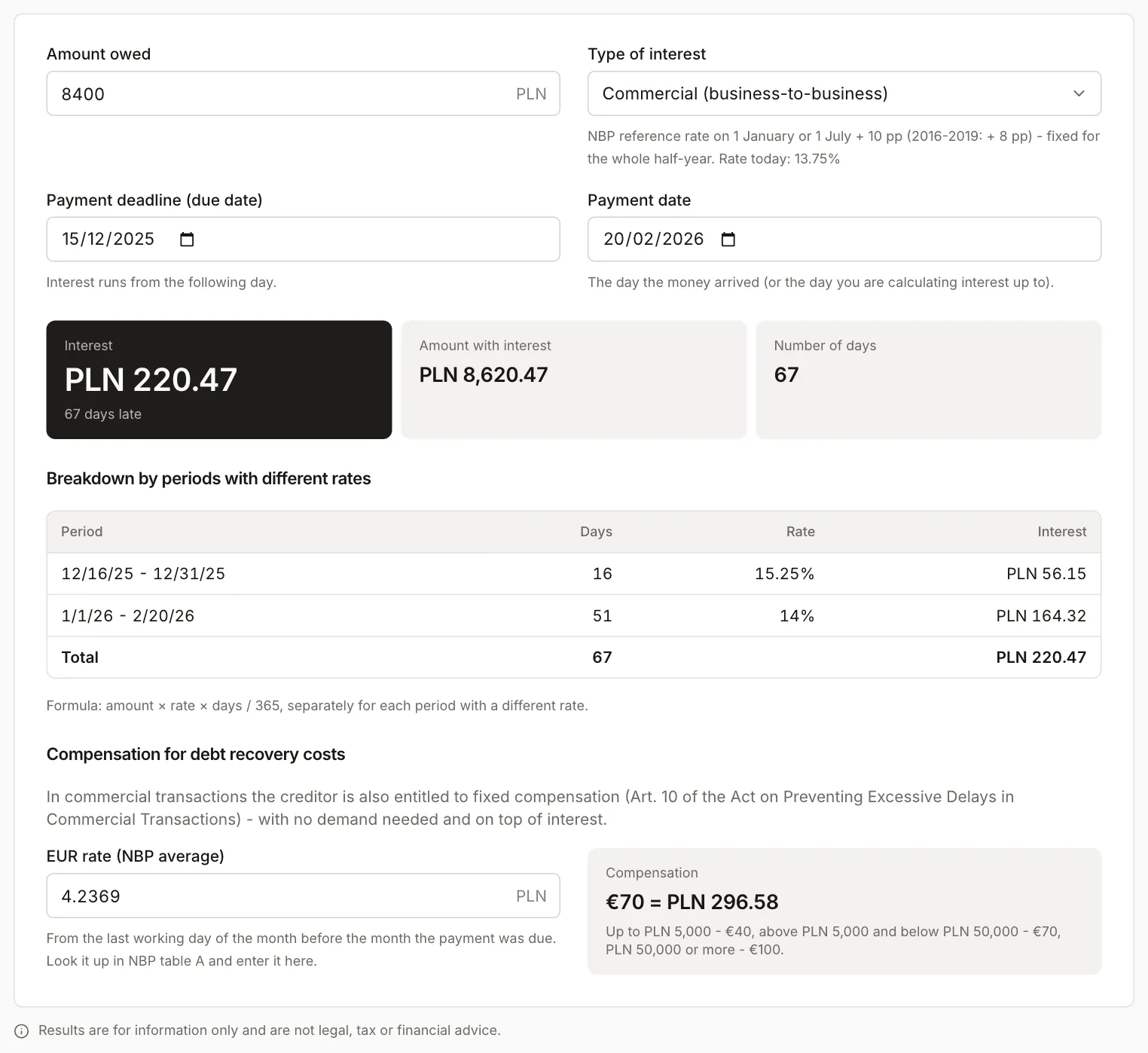
An invoice for PLN 8,400 due on 15 December 2025, paid on 20 February 2026. Both parties are businesses. Interest splits into two periods because the commercial rate fell on 1 January:
| Period | Days | Rate | Interest |
|---|---|---|---|
| 16 Dec 2025 - 31 Dec 2025 | 16 | 15.25% | PLN 56.15 |
| 1 Jan 2026 - 20 Feb 2026 | 51 | 14% | PLN 164.32 |
| Total | 67 | PLN 220.47 |
Compensation comes on top: PLN 8,400 falls in the EUR 70 band. The NBP average EUR rate on 28 November 2025 (the last working day of November) was 4.2369, so 70 × 4.2369 = PLN 296.58. If the same invoice had been issued to a consumer, Art. 481 interest at 9.5% would have been PLN 146.48, which is PLN 73.99 less.
Example 2: late payment interest and an NBP rate change
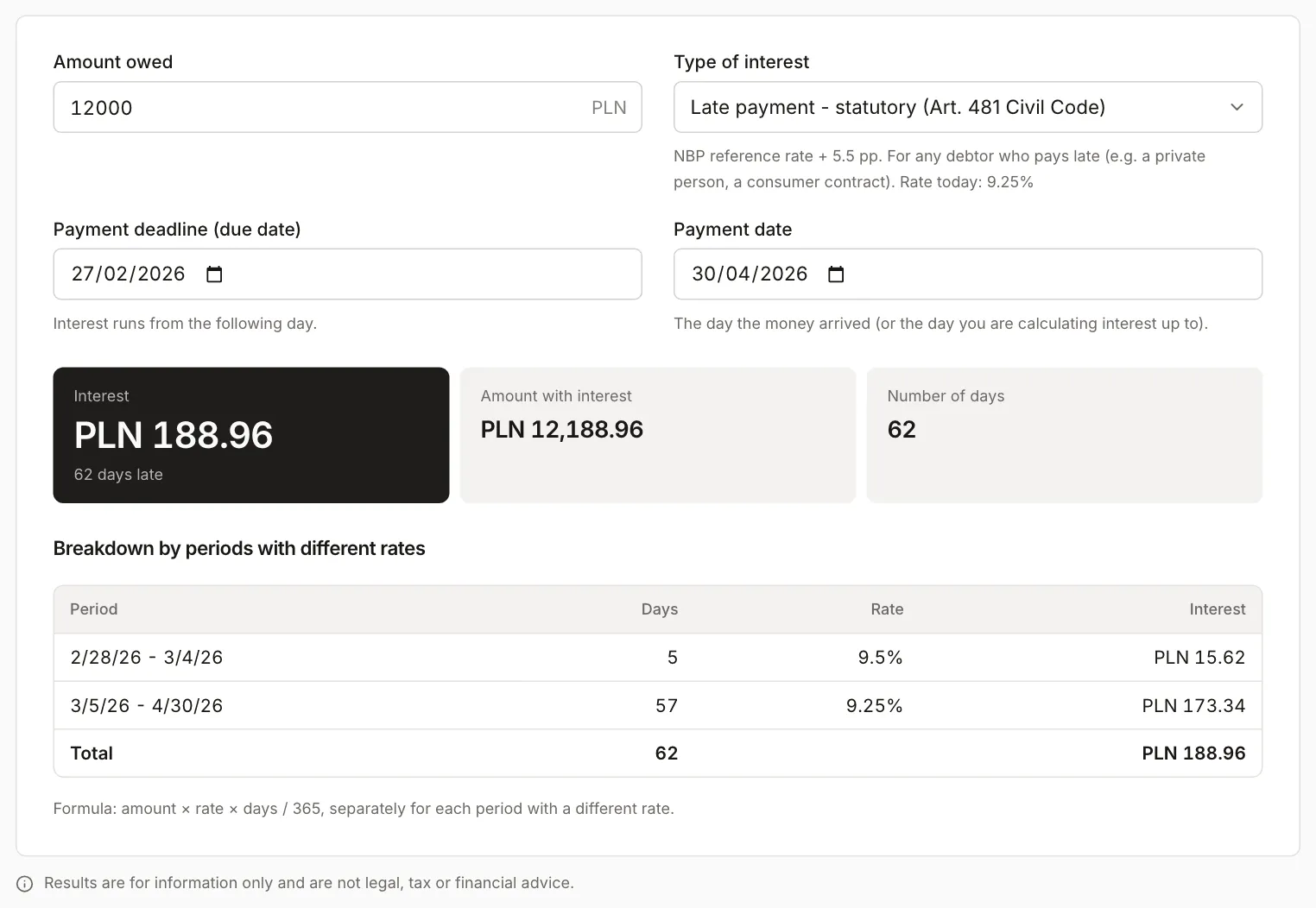
A debt of PLN 12,000 due on 27 February 2026, paid on 30 April 2026, Art. 481 interest. The reference rate fell on 5 March, so there are two periods: 5 days at 9.5% (PLN 15.62) and 57 days at 9.25% (PLN 173.34). That is 62 days and PLN 188.96 in total, or PLN 12,188.96 with the principal.
Example 3: a Saturday deadline
This is the PLN 6,500 debt from the Art. 115 section: PLN 54.36 of interest with a deadline of 15 August and PLN 51.07 with 17 August 2026, paid on 17 September.
What the calculator does not do
- It takes one amount and one payment date. For partial payments, calculate each part separately or calculate interest on the remaining amount in later periods.
- It knows only statutory rates. Contractual interest, interest on interest and contractual penalties have to be calculated outside it.
- It treats the amount as zloty. An invoice in euros or another currency needs a check of which currency and which amount interest runs on.
- It does not check whether the claim has become time-barred or whether the contract changes the payment deadline.
- It covers interest from 15 December 2008 (commercial interest from 1 January 2016). Earlier periods need the announcements in force at the time.
The result is indicative and is not legal advice. Before you send a payment demand or file a claim, check the rates against the current announcements, and consult a lawyer if the matter is disputed.
Sources (checked in October 2026)
- Act of 8 March 2013 on preventing excessive delays in commercial transactions, consolidated text, Journal of Laws 2023 item 1790 (Polish text; Art. 2-4a, 5-8, 10, 11, 11b, 11c). The ELI register lists no amendments newer than 2023.
- Civil Code, consolidated text, Journal of Laws 2026 item 795 (Polish text; Art. 115, 359, 481).
- Announcements of the Minister of Justice of 8 April 2026: late payment interest, M.P. 2026 item 367 and statutory interest, M.P. 2026 item 368.
- Announcements on commercial interest: from 1 Jul 2025, M.P. 2025 item 602, from 1 Jan 2026, M.P. 2025 item 1257, from 1 Jul 2026, M.P. 2026 item 642.
- NBP average EUR rate of 28 Nov 2025, table A.
- Directive 2011/7/EU on combating late payment in commercial transactions (Art. 3 and 6).