Law & business
Sick pay in Poland 2026: how much L4 pays (80%, 100%) and maternity benefit (81.5%)
On Polish sick leave (L4) you get 80% of your benefit base, which is your average gross pay over 12 months minus 13.71%, and 100% if you are pregnant. This guide shows who pays for L4, how the daily rate is built, and compares the two ways of calculating maternity benefit for a PLN 6,000 gross salary.
- HNarzędzia editorial team
- Published:
If you work in Poland on an employment contract, a doctor’s sick note (zwolnienie lekarskie, known as L4) pays 80% of your benefit base. The rate is 100% if the illness falls during pregnancy, if you were hurt in an accident on the way to or from work, or if the leave is for tests or a procedure as a donor of cells, tissue or organs. The base is your average gross pay over the last 12 months minus 13.71% for employee social contributions. At PLN 6,000 gross the base is PLN 5,177.40, and one day of L4 is PLN 138.06 (80%) or PLN 172.58 (100%). Your employer pays for the first 33 days in a calendar year, and ZUS (Zakład Ubezpieczeń Społecznych, the state social insurance institution) pays from day 34. The sick pay calculator works this out from your salary and the number of days, and the maternity benefit calculator compares the options for maternity benefit.
Where the benefit base comes from
The same base is used for sickness benefit, employer sick pay and maternity benefit. The Act on cash benefits from social insurance in case of sickness and maternity (the “benefits act” below) sets it out in Article 36:
- It is the average monthly pay from the 12 calendar months before the month in which the incapacity started. If your insurance is shorter than that, the average of the full months of insurance is used.
- The employee contributions are deducted: pension 9.76%, disability 1.5% and sickness 2.45%, 13.71% in total. For PLN 6,000 gross that is PLN 822.60, so the base is PLN 5,177.40.
- The daily base is 1/30 of the monthly base, whatever the length of the month.
- For a full-time job the base cannot be lower than the minimum wage minus 13.71% (Article 45). The minimum wage from 1 January 2026 is PLN 4,806, so the floor is PLN 4,147.10. For part-time work it is proportionally lower, which is what the “Working time (FTE)” field in the calculator is for.
Bonuses and other components paid for monthly periods count towards the base. Quarterly and annual components count as one twelfth of the amounts for the last four quarters or for the previous year (Article 42). If part of your pay varies, HR can tell you the exact average, because the calculator takes a single average amount.
What percentage L4 pays
The rates come from Article 92 of the Labour Code (sick pay paid by the employer) and Article 11 of the benefits act (sickness benefit paid by ZUS). Both give the same rates.
| Situation | Share of the base |
|---|---|
| Ordinary illness | 80% |
| Illness during pregnancy | 100% |
| Accident on the way to or from work | 100% |
| Tests as a candidate donor of cells, tissue or organs, and the donation procedure | 100% |
A hospital stay does not lower the rate. Since 1 January 2022 sickness benefit is 80% for days in hospital too, and 100% in the three situations above, as ZUS states on its page about the amount of sickness benefit. Accidents at work and occupational diseases fall under a separate act that this guide does not cover (Article 1(2) of the benefits act).
Sickness benefit is paid for every calendar day of incapacity, including weekends and public holidays (Article 11(4)). So you enter calendar days from the sick note in the calculator, not working days.
Who pays: your employer or ZUS
For the first 33 days of incapacity in a calendar year your employer pays sick pay (wynagrodzenie chorobowe). If you are over 50, the employer pays for 14 days a year. This applies to incapacity after the calendar year in which you turned 50 (Article 92(1), (4) and (5) of the Labour Code). Days from separate sick notes in the same year add up: if you were off for 30 days in March, your employer pays for 3 more days of a September sick note and ZUS pays for the rest.
From day 34 (or from day 15 for people over 50) you receive sickness benefit (zasiłek chorobowy) under the benefits act. ZUS calculates and pays it. If your employer reports more than 20 people to the sickness insurance, the employer calculates and pays it, using ZUS money (Article 61(1)). The number of people is counted as of 30 November of the previous year.
Sickness benefit is paid for up to 182 days, or up to 270 days for tuberculosis and illness during pregnancy (Article 8(1)). After that ZUS can grant a rehabilitation benefit if further treatment is expected to restore your ability to work (Article 18).
The waiting period
You first have to earn the right to sickness benefit (Article 4 of the benefits act):
- an employee insured compulsorily after 30 days of continuous sickness insurance,
- a person insured voluntarily after 90 days.
Earlier insurance counts if the break between the periods was no longer than 30 days. There is no waiting period for an accident on the way to or from work, for graduates who joined the insurance within 90 days of finishing school or university, or for people insured compulsorily who already have at least 10 years of earlier compulsory sickness insurance.
This matters to your employer too: sick pay is not due if you have no right to sickness benefit (Article 92(3) point 2 of the Labour Code). For maternity benefit, Article 29 of the benefits act only requires that the birth or the adoption of the child falls within a period of sickness insurance or childcare leave (urlop wychowawczy).
Example: PLN 6,000 gross, 10 days of L4 and 10 days of L4 in pregnancy
A full-time employee with an average of PLN 6,000 gross over 12 months, no earlier sick leave this year, 12% income tax advance. Two separate sick notes of 10 days each.
| Item | 10 days of L4, 80% | 10 days of L4 in pregnancy, 100% |
|---|---|---|
| Benefit base | PLN 5,177.40 | PLN 5,177.40 |
| Daily rate | PLN 138.06 | PLN 172.58 |
| Gross for 10 days | PLN 1,380.60 | PLN 1,725.80 |
| Income tax advance 12% | PLN 166 | PLN 207 |
| Health contribution 9% | PLN 124.25 | PLN 155.32 |
| Net (estimate) | PLN 1,090.35 | PLN 1,363.48 |
The base is PLN 6,000 minus PLN 822.60 of contributions. The daily rate is the base times the percentage divided by 30, rounded to the grosz: 5,177.40 × 80% ÷ 30 = 138.064, so PLN 138.06. At 100% it is PLN 172.58. The two sick notes together come to PLN 3,106.40 gross.
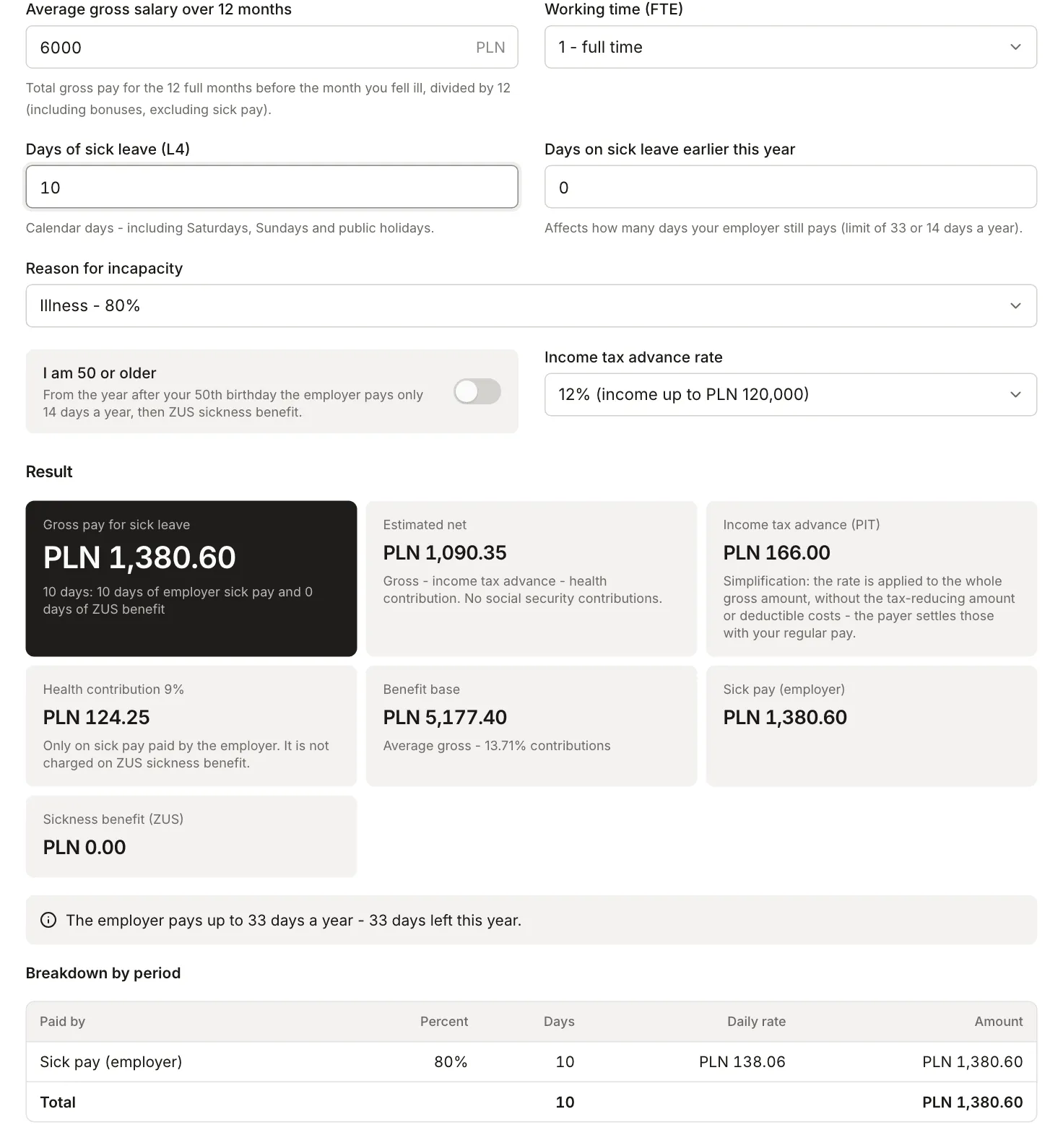
Here the employer pays for every day, because they fall within the 33-day limit. For a single sick note of 40 days the calculator shows 33 days at PLN 138.06 from the employer (PLN 4,555.98) and 7 days at PLN 138.06 from ZUS (PLN 966.42), PLN 5,522.40 gross in total. After the income tax advance (PLN 663) and the health contribution on the employer-paid part (PLN 410.04), about PLN 4,449.36 is left. The daily rate is the same, only the payer changes.
The net amount in the calculator is the gross amount minus the income tax advance (12%) and the health contribution (9%). Pension, disability and sickness contributions are not charged on sick pay or on benefits (Article 18(2) of the Act on the Social Insurance System). The health contribution does apply to sick pay paid by the employer, but not to ZUS sickness benefit (Article 81(1) and (5) of the Act on Healthcare Services Financed from Public Funds), so the calculator charges it only on the days paid by the employer.
The income tax advance is a simplification: the rate is applied to the whole gross amount, without tax-deductible costs or the tax-reducing amount. Your employer settles those together with the rest of your pay for the days you worked, and for ZUS benefit they depend on the PIT-2 form you filed. For the exact payout for a month that includes L4, ask your HR or payroll department, or check the ZUS statement.
Maternity benefit: two options
Maternity benefit (zasiłek macierzyński) is calculated from the same base. Article 31 of the benefits act gives two ways:
| Option | Maternity leave | Parental leave |
|---|---|---|
| No Article 30a application within 21 days of the birth | 100% | 70% |
| Application filed no later than 21 days after the birth | 81.5% | 81.5% |
With the 81.5% option you get the same amount for the whole leave. The application must be in writing and cover benefit for maternity and parental leave in full (Article 30a). ZUS also describes a second route: an application for maternity leave only, with a declaration that you will use the whole of parental leave. You then submit the parental leave request within the statutory deadline, which is 21 days before it starts (as ZUS describes it).
Maternity leave lasts 20 weeks for one child, 31 for twins, 33 for triplets, 35 for four children and 37 for five or more (Article 180(1) of the Labour Code). Parental leave is 41 weeks for one child and 43 for a multiple birth, and 9 weeks of it belong exclusively to each parent and cannot be transferred (Article 182¹a(1) and (4)). So the mother can take 32 weeks of parental leave and the other parent 9. For those 9 weeks the benefit is always 70% of the base (Article 31(3f)).
Example for PLN 6,000 gross
One child, 20 weeks of maternity leave and 32 weeks of parental leave, base PLN 5,177.40. Net assumes a 12% tax advance reduced by PLN 300 (the payer applies the tax-reducing amount after you file a PIT-2 form). The calculator takes the daily amount as the monthly amount divided by 30 and multiplies it by the number of days.
| 81.5% for the whole period | 100% + 70% | |
|---|---|---|
| Maternity leave, 20 weeks | PLN 4,219.58 a month | PLN 5,177.40 a month |
| Parental leave, 32 weeks | PLN 4,219.58 a month | PLN 3,624.18 a month |
| Net a month (maternity / parental) | PLN 4,013.58 / PLN 4,013.58 | PLN 4,856.40 / PLN 3,489.18 |
| For 20 weeks | PLN 19,691.00 | PLN 24,161.20 |
| For 32 weeks | PLN 31,505.60 | PLN 27,061.44 |
| Total gross | PLN 51,196.60 | PLN 51,222.64 |
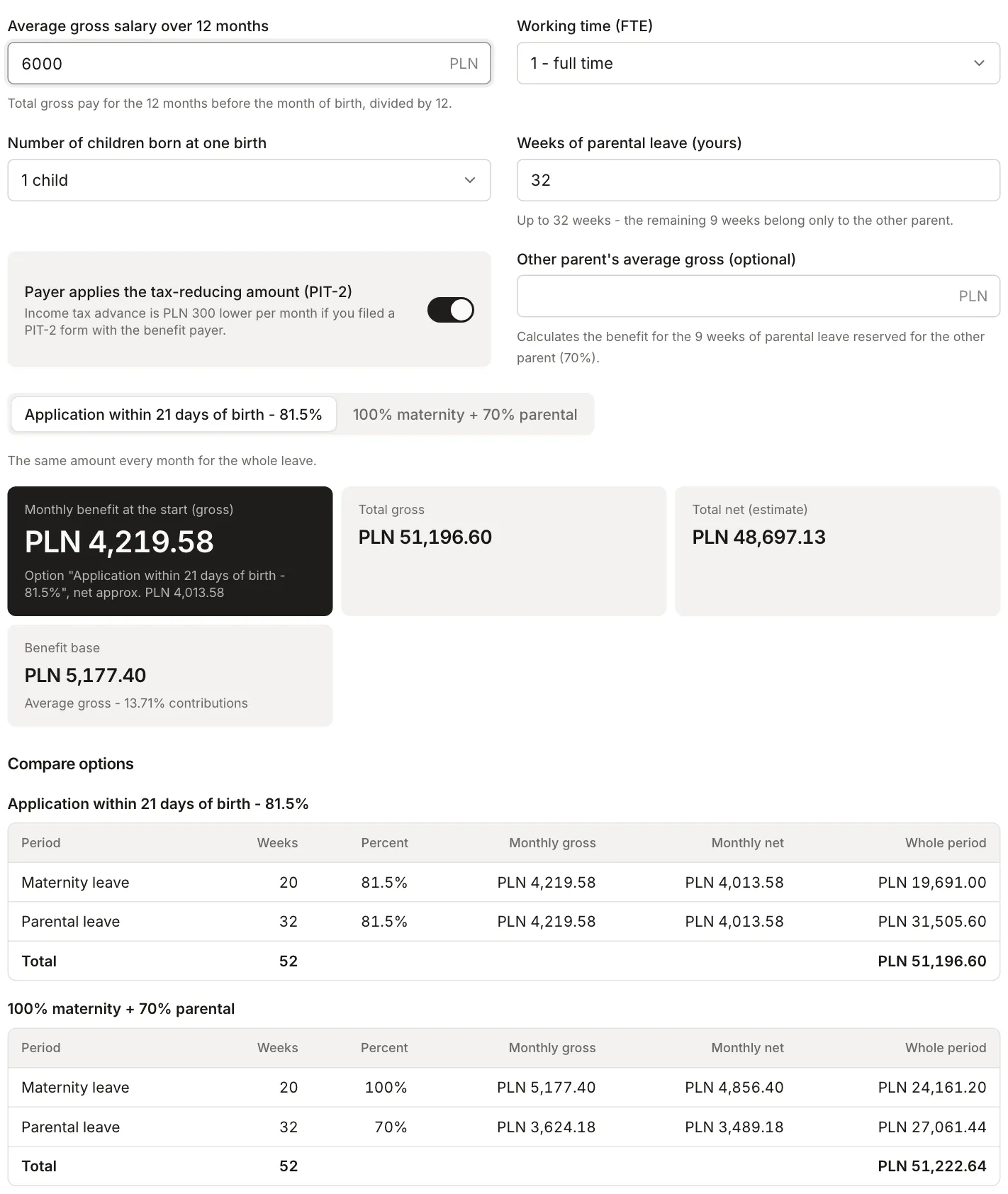
If you take the whole leave, the difference is PLN 26.04 in favour of 100% + 70%, so the choice comes down to when you want the money. The 100% + 70% option pays PLN 957.82 more a month for the first 20 weeks and PLN 595.40 less a month during the 32 weeks of parental leave. The 81.5% option spreads the same total evenly.
The gap grows if you do not use all of the parental leave. With the same assumptions and 16 weeks of parental leave, the calculator shows PLN 35,443.80 with 81.5% and PLN 37,691.92 with 100% + 70%, which is PLN 2,248.12 more. If, in the first year of the child’s life, you do not use a single day of parental leave benefit under the 81.5% option, you can apply for a one-off top-up of the maternity leave benefit to 100% of the base, and the parental leave benefit is 70% (Article 31(3g) and (4)). In that case you receive PLN 24,161.20 gross for the 20 weeks of maternity leave.
The benefit cannot be lower than the parental allowance (świadczenie rodzicielskie), PLN 1,000 a month (Article 31(3a) of the benefits act). If the benefit after the income tax advance is below PLN 1,000, the payer tops up the difference, and the top-up itself is tax-free (Article 21(1)(82a) of the Personal Income Tax Act). The calculator works the same way, so with a very low base (for example a small fraction of a full-time job) the net amount is PLN 1,000 and the gross amount is higher by the amount of the tax advance. No social security or health contributions are charged on maternity benefit, only the income tax advance.
For the other parent the calculator works out 9 weeks of benefit at 70% of their own base. With the same salary of PLN 6,000 gross that is PLN 3,624.18 a month and PLN 7,611.03 for the whole period.
Self-employed people and contractors
For them sickness insurance is voluntary. Sickness benefit is due after 90 days of insurance (Article 4(1) of the benefits act), and ZUS pays it. For people running a business ZUS always pays the benefits, and for contractors it is ZUS or a payer that reports more than 20 people to the sickness insurance (Article 61(1)). The percentages are the same as for employees. The base is the average monthly income over 12 months minus 13.71% (Article 2 point 4 and Article 48), not a salary from an employment contract. The 33 and 14 day rules from the Labour Code do not apply to them. Sickness, maternity and care benefits are not paid to a self-employed person who owes social insurance contributions of more than 1% of the minimum wage (PLN 48.06 in 2026) until the debt is repaid (Article 2a). The calculators in this guide calculate amounts for employees, so you cannot use them unchanged for a business owner or contractor. Check the details on the ZUS pages about sickness and maternity benefit or call the ZUS helpline.
Changes in 2026
Since 13 April 2026 the benefits act spells out when you lose sickness benefit for the whole period of the sick note (Article 17(1), (1a) and (1b)). This happens if, during the certified incapacity, you do paid work or do something that is incompatible with the purpose of the sick leave. Paid work is any activity of a gainful nature, whatever the contract, except incidental tasks that significant circumstances require. An instruction from your employer is not such a circumstance. An activity incompatible with the purpose of the leave is anything that hinders or prolongs treatment or recovery, other than ordinary everyday activities and incidental tasks. Since sick pay is not due to someone with no right to sickness benefit (Article 92(3) point 2 of the Labour Code), losing the benefit in practice also means losing sick pay from the employer.
On 1 January 2027 further changes from the same amending act take effect, including rules for sick leave when you are insured under more than one title and for deciding on rehabilitation benefit. The percentages of sickness and maternity benefit in the consolidated text of the act from June 2026 are as described above.
What the calculators do not cover
- A full monthly payout that includes L4: pay for days worked, contributions and tax settled together with the salary. Your payer does this on the payroll.
- Care benefit, rehabilitation benefit and benefits for accidents at work.
- A base with variable pay components or a shorter insurance period, unless you enter the average yourself.
- Amounts for self-employed people and contractors with voluntary sickness insurance.
- Income tax advance rates other than 12% and 32%.
A calculator result is an estimate. The binding amounts are set by the payer of the benefit, your employer or ZUS. For how gross pay turns into net pay on an employment contract, see the guide to Polish gross to net salary.
Sources
The legal texts were checked in October 2026, using the consolidated versions. The acts are published in Polish only.
- Act on cash benefits from social insurance in case of sickness and maternity, consolidated text, Journal of Laws 2026 item 854: Articles 2a, 4, 8, 11, 17, 18, 29, 30a, 31, 36, 42, 45, 48 and 61.
- Labour Code, consolidated text, Journal of Laws 2026 item 1245: Articles 92, 180 and 182¹a.
- Act on the Social Insurance System, consolidated text, Journal of Laws 2026 item 199: Article 18(2).
- Act on Healthcare Services Financed from Public Funds, consolidated text, Journal of Laws 2025 item 1461: Article 81(1) and (5).
- Personal Income Tax Act, consolidated text, Journal of Laws 2026 item 592: Article 21(1)(82a).
- ZUS: amount of sickness benefit (in Polish), checked in October 2026.
- ZUS: amount of maternity benefit (in Polish), checked in October 2026.
- ZUS: sickness benefit and maternity benefit (in Polish).
The amounts in this guide come from the HNarzędzia calculators. They are for information only and are not legal, tax or financial advice. Your employer or ZUS confirms the actual payment.