Law & business
Buying or selling a used car in Poland: contract, PCC tax, registration and insurance
In a private car sale in Poland the signature starts several clocks: 14 days for the buyer's PCC tax and for the seller's letter to the insurer, 30 days to report the sale and to register the car. This guide shows who does what, using a PLN 24,500 car sold by two co-owners.
- HNarzędzia editorial team
- Published:
If you buy or sell a used car from a private person in Poland, the paperwork after the handover matters as much as the contract. The buyer pays a tax and registers the car, and the seller reports the sale and informs the insurer. All deadlines run from the date of the agreement. The car sale agreement generator produces the contract as a PDF, and the PCC tax calculator works out the buyer’s tax. Rules and official pages were checked in October 2026, and the sources are listed at the end.
A few Polish terms you will meet: PCC is the civil law transactions tax (podatek od czynności cywilnoprawnych). The starosta is the local authority whose vehicle registration office (wydział komunikacji) handles car registration. OC is compulsory third-party liability insurance. PESEL is the Polish personal ID number, and the registration certificate is the dowód rejestracyjny.
Who does what, and by when
| Obligation | Who | Deadline | Legal basis | Consequence |
|---|---|---|---|---|
| PCC-3 return and payment of the tax | buyer | 14 days from signing | Art. 10(1) of the PCC Act | tax arrears |
| Written notice to the OC insurer | seller | 14 days from the sale | Art. 32(1) of the Compulsory Insurance Act | the seller stays jointly liable for the premium until the insurer is told |
| Notice of the sale to the starosta | seller | 30 days from the sale | Art. 78(2)(1) of the Road Traffic Law | PLN 250 fine |
| Application to register the car | buyer | 30 days from acquiring it | Art. 73aa(1)(1) of the Road Traffic Law | PLN 500 fine, PLN 1,000 after 180 days |
The fines come from Art. 140mb of the Road Traffic Law and are imposed by the starosta in an administrative decision.
What goes into the contract
Polish law does not require a notary for a car sale. You do need a written agreement, though: the buyer uses it as proof of ownership when registering the car, and gov.pl warns that an office can refuse a copy where an original is required. So each party should get its own signed copy.
The agreement should contain:
- the date and place of signing,
- both parties’ full name, address, PESEL and ID document number,
- the car’s make, model, year, VIN, registration number, registration certificate number and mileage,
- the price in figures and in words, and how it is paid,
- the seller’s statement that the car is theirs and free of third-party claims, and the buyer’s statement that they know its technical condition,
- handover of the car with documents and keys, and the signatures of everyone involved.
The generator adds standard clauses on PCC, the reporting deadlines and the transfer of the insurance policy. The agreement is produced in Polish, because Polish offices work with Polish documents. The form is in English, and the preview shows exactly the Polish text that will be printed. Print the Polish version for signing, and keep your own translation next to it if you need one to understand what you sign.
The “Exclude statutory warranty” switch adds a clause that removes the seller’s liability for physical defects (Art. 558(1) of the Civil Code). It has no effect if the seller deliberately concealed a defect (Art. 558(2)), and it is restricted when a business sells to a consumer. If you are unsure which case applies to you, ask a lawyer.
If you are not in the PESEL register, leave that field empty. The PDF will print a dotted blank that you fill in by hand, and the form has a separate field for your passport or ID card number. The insurer notice rules also expect a PESEL only “if assigned” (Art. 32(2) of the Compulsory Insurance Act).
Example: a PLN 24,500 Golf with two co-owners
The example uses invented data: two sellers (Anna Zielińska and Marek Zieliński), a buyer (Tomasz Wrona), a 2014 Volkswagen Golf VII 1.6 TDI with 187,400 km, a price of PLN 24,500 and an agreement signed on 12 October 2026 in Poznań. The PESEL and VIN numbers have valid check digits but belong to no real person or car. In the generator we switched on “Two co-owners”, chose “Bank transfer before signing” and the warranty exclusion, and wrote under “Additional terms” that the price was transferred to one seller’s account with the other seller’s consent.
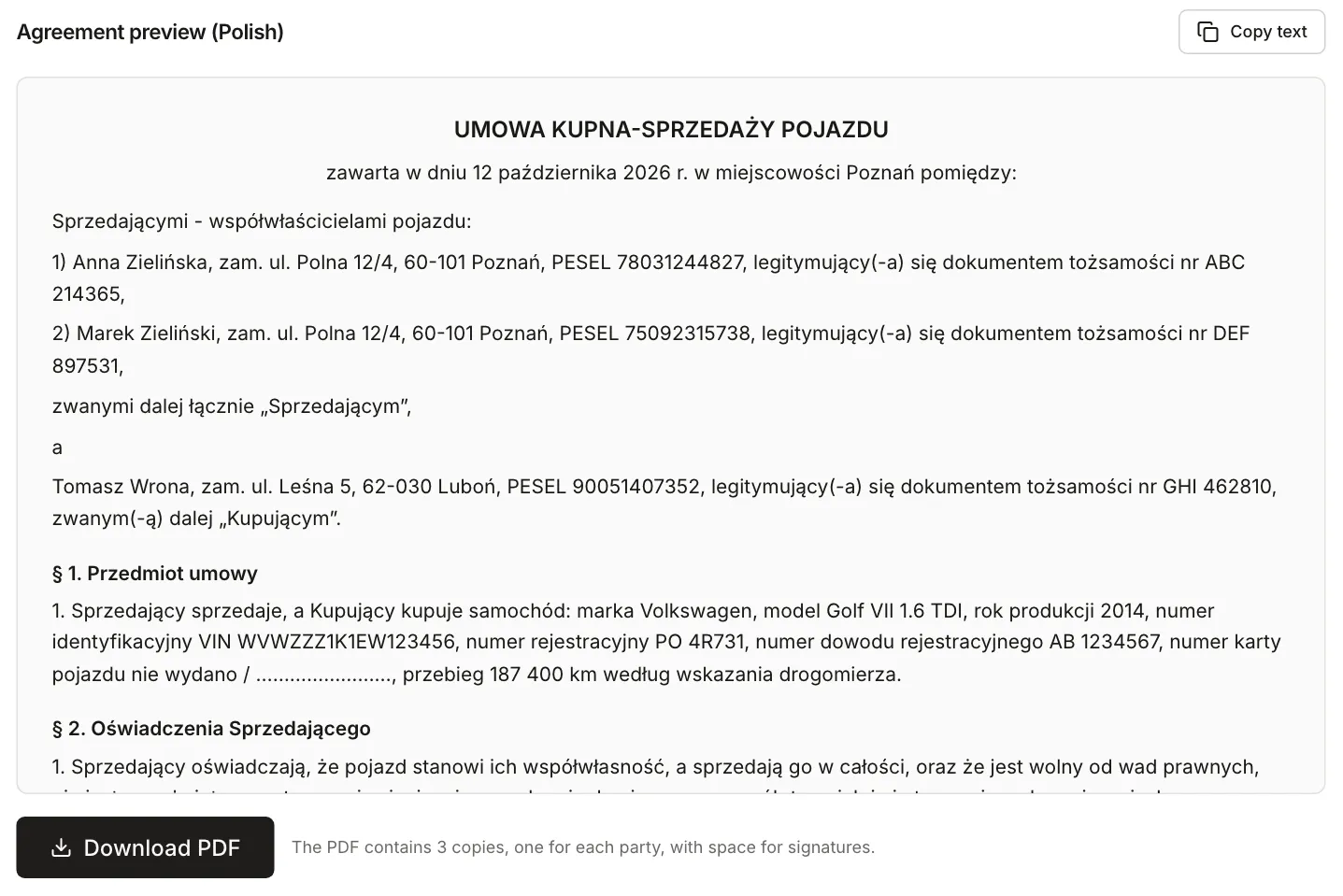
The price in words (“dwadzieścia cztery tysiące pięćset złotych 00/100”) filled in on its own. The VIN field confirmed the format, and the PESEL fields showed no warnings. The PDF has 6 A4 pages: three copies, one for each party, two pages each, with signature lines for “Sprzedający 1”, “Sprzedający 2” and “Kupujący” (seller 1, seller 2, buyer) and a label such as “Egzemplarz 1 z 3” in the corner. With one seller you get two copies.
Which fields are required
The generator blocks nothing. Even an empty form produces a PDF, with dotted blanks in about 70 places to fill in by pen. That helps when you do not know something yet, but an agreement with blanks is not worth signing. These are the fields to complete before signing, with what the tool checks in each:
| Field | What the tool checks |
|---|---|
| Date of the agreement | Defaults to today. The deadlines above run from it. |
| PESEL of each party | Checksum. A mistake shows as an amber warning, not a block. |
| VIN | 17 characters, no letters I, O or Q. A mismatch in the 9th character (the check digit) is only a note, because many European cars do not follow that rule. |
| Price | Must be a number. The amount in words then appears. |
| Payment method | Cash, bank transfer before signing or bank transfer by a deadline. The last option needs an account number and a date. |
| Vehicle card number | Leave empty if no vehicle card was issued. |
PCC tax: 2%, paid by the buyer, within 14 days
The buyer pays civil law transactions tax on a car sale (Art. 4(1) of the PCC Act). The rate for movable property is 2% (Art. 7(1)(1)(a)), and the base is the car’s market value, not the price on paper (Art. 6(1)(1)). Market value means the average price of similar items, taking condition and wear into account (Art. 6(2)). The seller files nothing. If there are several buyers, they are jointly liable (Art. 5(2)).
The deadline is 14 days from the day the tax obligation arises, which is the day the agreement is made (Art. 3(1)(1) and Art. 10(1)). Within that time the buyer files a PCC-3 return and pays. You can complete the return online in e-Urząd Skarbowy, the tax office’s online service.
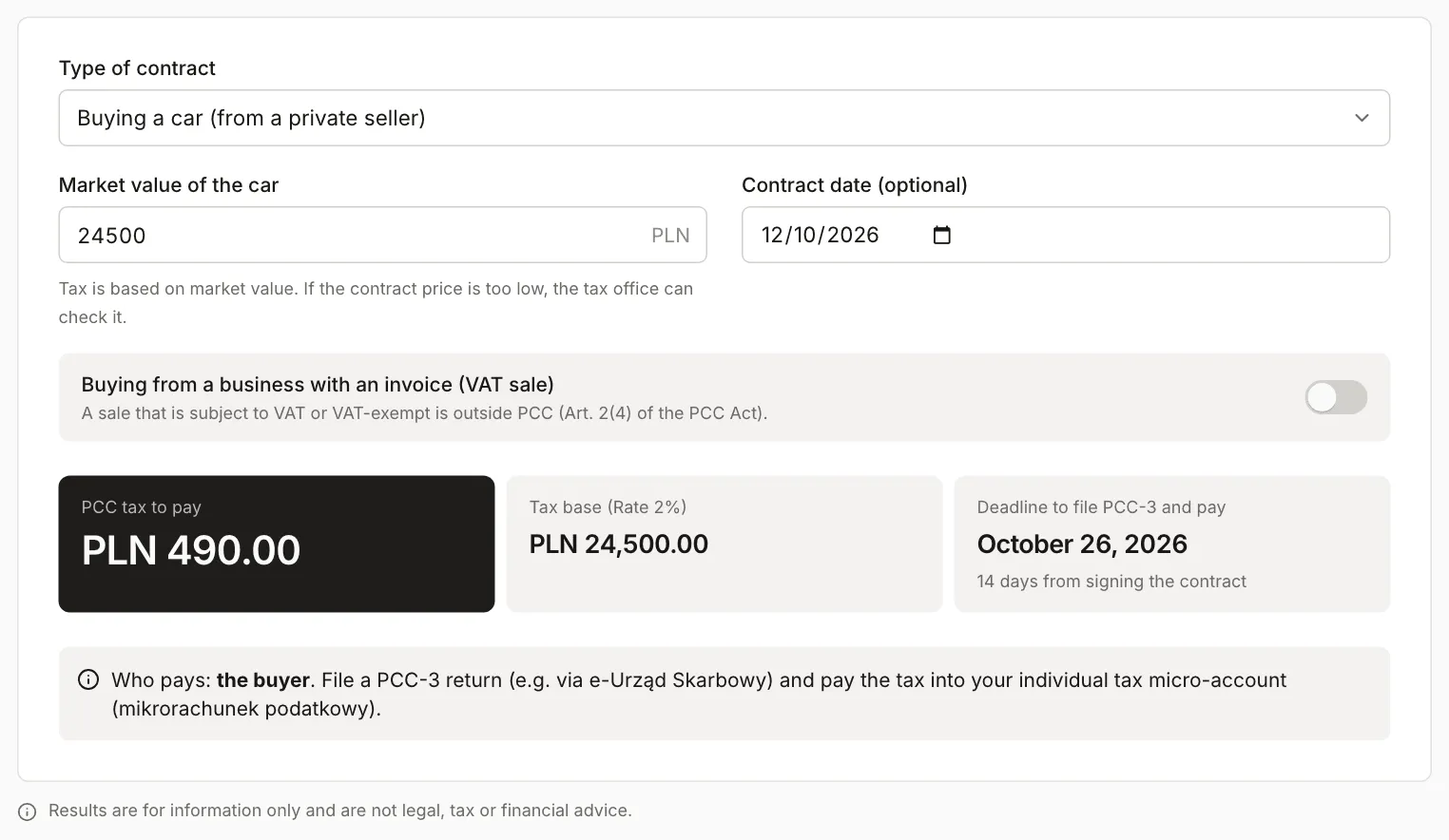
For the PLN 24,500 car the calculator showed PLN 490 (2% of PLN 24,500). For an agreement dated 12 October 2026 the deadline falls on Monday, 26 October. If the fourteenth day lands on a Saturday or a public holiday, the calculator moves the deadline to the next working day. The guide Working days in Poland in 2026 and 2027 explains how that works. The tax is rounded to whole złoty.
Two situations come up often where there is no PCC:
- The car’s market value is PLN 1,000 or less (Art. 9(6)). The calculator shows PLN 0 at PLN 1,000 and PLN 20 at PLN 1,001.
- You buy from a business on a VAT invoice. A sale subject to VAT, or exempt from VAT, is outside PCC (Art. 2(4)). Use the “Buying from a business with an invoice” switch in the calculator.
A price below market value in the contract
A lower price on paper does not lower the tax for good. PCC is calculated on market value. If the tax office thinks the value declared by the buyer is not the market value, it asks the buyer to change it within at least 14 days and gives its own preliminary figure (Art. 6(3)). If the buyer does not react or keeps the lower figure, the office sets the value using an expert’s opinion or a valuation the buyer submits (Art. 6(4)). When the expert’s value differs from the declared one by more than 33%, the buyer pays for the opinion.
In the calculator a price of PLN 12,000 gives PCC of PLN 240 instead of PLN 490. The PLN 250 difference can be recovered by the office, together with the cost of the valuation and interest. If the car is cheaper for a concrete reason, such as accident damage, describe it in the agreement and write the price actually paid. Condition is one of the factors that decide market value.
Reporting the sale and registering the car
The seller
The seller must notify the starosta of the sale within 30 days (Art. 78(2)(1) of the Road Traffic Law). The notice goes to the starosta for the seller’s place of residence (Art. 78(2a)). On gov.pl you can file it online with a Polish trusted profile (profil zaufany) or a qualified electronic signature, attaching a scan of the agreement and the buyer’s details. If you do not have either, file in person or by post at the vehicle registration office, where a foreigner shows a passport or residence card. The service is free, and online you receive an official confirmation of submission. When a car has several owners, a notice from one co-owner is enough (Art. 78(2b)). The fine for no notice is PLN 250, and co-owners are jointly liable for it (Art. 140mb(6) and (7)). At handover the seller also gives the buyer the registration certificate (Art. 78(1)).
The buyer
Since 1 January 2024 the buyer no longer reports the acquisition separately and simply registers the car (gov.pl). The application is due within 30 days of acquiring the car (Art. 73aa(1)(1)), and a late application costs PLN 500, or PLN 1,000 after 180 days (Art. 140mb(1) and (5)). According to gov.pl you need, among other things, a document proving ownership (the agreement), the registration certificate with a valid technical inspection and the previous plates. The car must be insured before registration. The starosta may ask for more documents, and the office decides which ID it accepts from a foreign buyer, so check the list with your local office before going.
OC insurance when the car is sold
The seller’s OC policy does not end on the day of sale. Its rights and obligations pass to the buyer (Art. 31(1) of the Compulsory Insurance Act). The policy ends when the period it was taken for expires, unless the buyer terminates it earlier in writing, and the end date cannot be earlier than the day the notice is given. The insurer may recalculate the premium from the date of sale, using the buyer’s discounts and surcharges (Art. 31(2)). If the seller had no OC at all, the buyer must take out a policy on the day of acquisition, and at the latest before the first drive (Art. 31(3)).
The seller has two duties (Art. 32(1)). They must give the buyer proof of the OC policy and notify the insurer in writing within 14 days of the sale, naming the buyer: first name, surname, address and PESEL if one has been assigned. Until the insurer is told, the seller is jointly liable with the buyer for the premium (Art. 32(4)). Damage caused after the sale is not the seller’s responsibility (Art. 32(3)). The simplest approach is to send the letter on the day of sale, with a scan of the agreement.
Co-owned cars
If a car has two owners and only one signs, the buyer will in principle buy only that person’s share. Each co-owner may dispose of their own share (Art. 198 of the Civil Code), but disposing of the whole car needs everyone’s consent (Art. 199). In the generator, switch on “Two co-owners”: the agreement then names both, states that they sell the car as a whole, and the PDF has three copies and two seller signature lines.
Agree in the contract whose account receives the price, because the form assumes a single “Seller” account. In the example this went into “Additional terms”. PCC is paid by the buyer alone. One co-owner can file the sale notice, but both are liable for the fine if nobody does. The generator handles at most two co-owners, so with three or more add the details by hand. If the registration certificate lists one person but two people own the car, for example in a marriage, the rules depend on the couple’s property regime, and a lawyer should look at it.
What the generated agreement does not cover
- It is a template, not legal advice. The generator does not know your situation, so read the whole preview before signing and change what does not fit.
- It is produced in Polish only, and the PDF is not electronically signed.
- It does not handle attorneys, three or more co-owners or a car bought abroad. A car imported from another country involves excise duty and a different registration route, so start with the gov.pl page on registering a vehicle.
- It says nothing about the seller’s income tax. Check podatki.gov.pl if you sell a car soon after buying it.
Sources (checked in October 2026)
- Act of 9 September 2000 on civil law transactions tax, consolidated text, Dz. U. 2026 item 191 (Art. 2-6, 9, 10).
- Road Traffic Law, consolidated text, Dz. U. 2024 item 1251 as amended (Art. 73aa, 78, 140mb, 140n). The 2025-2026 amendments do not change the deadlines or fines for an ordinary purchase and sale.
- Act on compulsory insurance, the Insurance Guarantee Fund and the Polish Motor Insurers’ Bureau, consolidated text, Dz. U. 2026 item 783 (Art. 31-32).
- Civil Code, consolidated text, Dz. U. 2026 item 795 (Art. 198, 199, 558).
- Report the sale or acquisition of a vehicle, gov.pl and Register a vehicle, gov.pl (in Polish).
- PCC: reliefs and exemptions and PCC-2, PCC-3, PCC-4 forms on podatki.gov.pl (in Polish).