Law & business
Ending a job in Poland: notice period, annual leave, pay in lieu and severance
Your last day of work depends on how long you have worked for your employer and on the day the notice reached the other side. At the end of a contract you also need to settle your leave and check whether severance is due. This guide works through all four with one example from 2026.
- HNarzędzia editorial team
- Published:
Once an employment contract has been terminated in Poland, four things need settling: when the notice period ends, how much annual leave you earn in your last year, whether unused leave is taken or paid out, and whether the employer owes severance. Each has its own calculator, and the results depend on each other. The end date decides how many months of leave you have earned, and your monthly pay feeds into both the leave payout and the severance. This guide follows one example through all four. The rules were checked in October 2026 and the sources are listed at the end. It covers an employee in Poland on an employment contract under the Labour Code (Kodeks pracy, abbreviated KP below).
The example
A fictional employee works full time on an indefinite-term contract and has been with the employer since 1 March 2022. They earn PLN 7,000 gross a month in fixed pay, with no bonuses, and finished general secondary school (liceum). On Wednesday 17 June 2026 the employer hands over notice because the position is being eliminated. The company has more than 20 employees. Before the contract ends the employee will have taken 10 days of leave from this year’s entitlement.
How long the notice period is
For indefinite-term and fixed-term contracts the notice period depends on how long the employee has worked for that employer (Art. 36 § 1 KP). The same periods apply when the employee is the one giving notice.
| Time with the employer | Notice period |
|---|---|
| less than 6 months | 2 weeks |
| at least 6 months | 1 month |
| at least 3 years | 3 months |
A probationary contract has its own periods (Art. 34): 3 working days if the probation is up to 2 weeks, 1 week if it is longer, and 2 weeks for a 3-month probation.
Time with the same employer includes time with a previous employer when the business was transferred to the current one (Art. 36 § 1¹ and Art. 23¹). Since 2026 the Labour Code also counts periods of self-employment and of civil-law contracts (umowa zlecenia and agency contracts), provided the person did the work for the same employer (Art. 302¹ § 8). The rules apply from 1 January 2026 at public-sector employers and from 1 May 2026 at all others, and an employee who was already employed on that date has 24 months to document the periods with a certificate from ZUS, the Social Insurance Institution. The change does not apply to notice that was already running on the day it took effect at that employer (Art. 8 of the Act of 26 September 2025). The calculator counts service from the single date you enter, so if this applies to you, ask HR from which date they count your service and enter that date. The hint under the “Employed by this employer since” field says the same.
Which day is the last one
A notice period counted in weeks ends on a Saturday. One counted in months ends on the last day of a month (Art. 30 § 2¹). The day notice is served is not part of the period, so counting starts on the next Sunday or on the 1st of the next month. These are the calculator’s results for notice served on Wednesday 17 June 2026:
| Employed since | Period | Starts | Last day |
|---|---|---|---|
| 2 March 2026 (3 months) | 2 weeks | Sunday 21 June | Saturday 4 July 2026 |
| 1 December 2025 (6 months) | 1 month | 1 July | Friday 31 July 2026 |
| 1 March 2022 (4 years 3 months) | 3 months | 1 July | Wednesday 30 September 2026 |
The last row is our employee. With notice served on 30 June the end date is also 30 September, but with notice served on 1 July it moves to Saturday 31 October 2026. One day’s difference in the delivery date shifts the end of the contract by a month, so what counts is the day the other side could read the notice. Weeks work the same way: a 2-week notice served on Wednesday 17 June ends on 4 July, and one served on Sunday 21 June ends on 11 July according to the calculator.
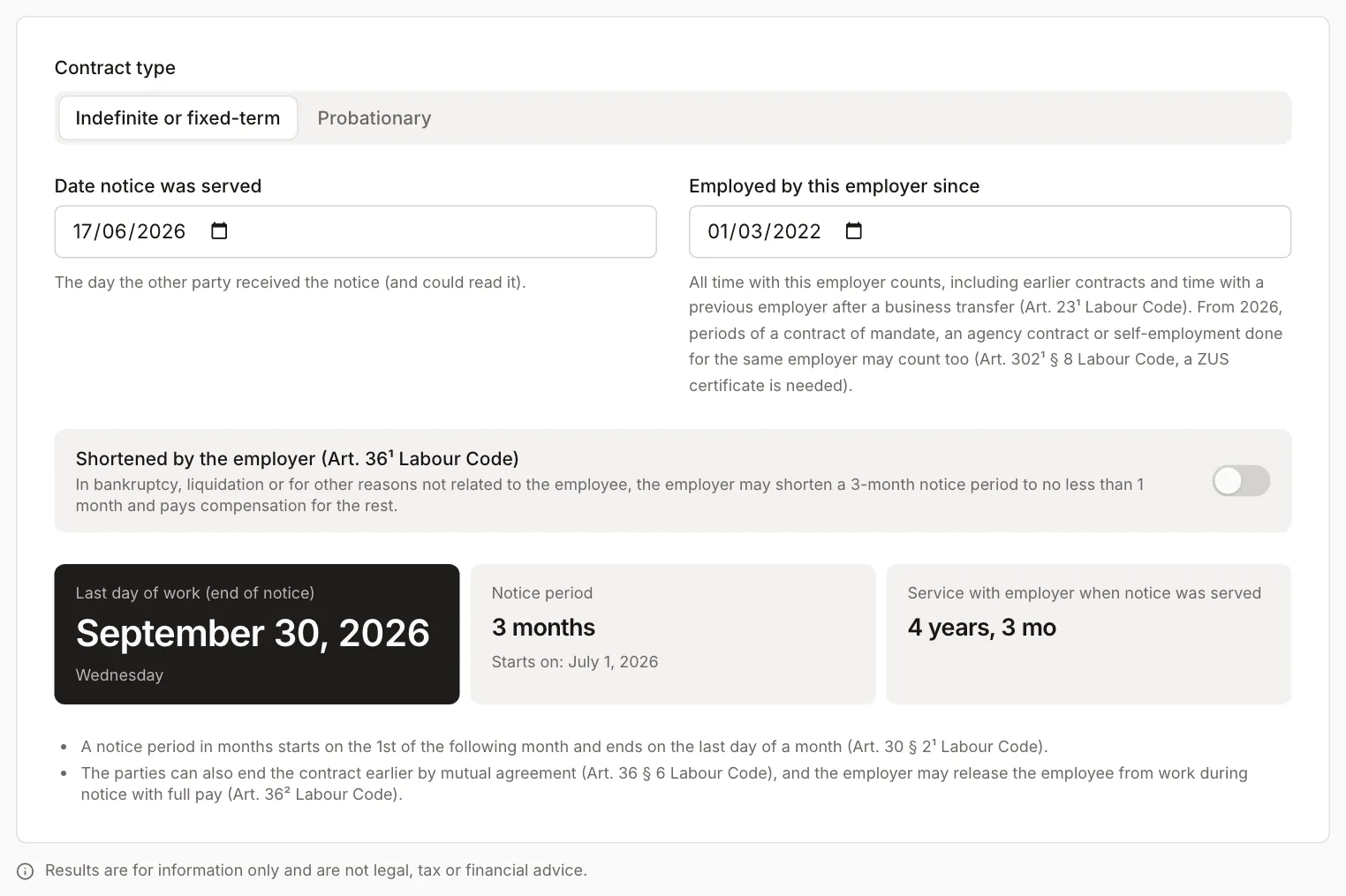
The Labour Code does not say explicitly on which day to measure service when the 6-month or 3-year threshold is passed during the notice period. The calculator then applies the longer period and shows a warning. In a case like that, ask HR or the National Labour Inspectorate (Państwowa Inspekcja Pracy, PIP).
Shortening, release from work and time off to job-hunt
- When notice is given because of the employer’s bankruptcy or liquidation, or for other reasons not related to the employee, the employer may shorten a 3-month period to 1 month at the least. The employer then pays compensation equal to the pay for the rest of the period, and that time counts as employment (Art. 36¹). In our example the contract would end on Friday 31 July 2026 and the employee would receive compensation for 2 months.
- The employer may release the employee from work until the end of the notice period and must keep paying their salary (Art. 36²).
- When the employer gives notice and the notice period is at least 2 weeks, the employee gets paid time off to look for a job: 2 working days for 2-week and 1-month notice, and 3 days for 3-month notice, including a shortened one (Art. 37).
- After notice has been given, the parties may agree on an earlier end date (Art. 36 § 6).
Annual leave in your final year
In the calendar year in which employment ends, the employee gets leave proportional to the time worked for that employer in that year, unless they have already taken that amount or more before the contract ends (Art. 155¹ § 1 point 1). Each calendar month of work is 1/12 of the annual entitlement, a part-month is rounded up to a full month (Art. 155²ᵃ), and a part-day of leave is rounded up to a full day (Art. 155³ § 1). Leave carried over from earlier years is separate and is not part of this entitlement.
The annual entitlement is 20 days with less than 10 years of service and 26 days from 10 years (Art. 154 § 1). Leave service includes all earlier employment regardless of gaps (Art. 154¹) plus completed school (Art. 155): 4 years for general secondary school, 8 years for university, and since 2026 also the self-employment and civil-law periods described above. This is a different measure from the service that sets the notice period, because it counts a whole career and not time with one employer.
Our employee has 4 years 7 months with this employer (to 30 September) plus 4 years for secondary school, which makes 8 years 7 months. The annual leave calculator shows an annual entitlement of 20 days (160 hours) and 1 year 5 months to go until the 26-day threshold. With the “My employment ends this year” option switched on and the end date entered, 30 September 2026, the calculator also gives the proportional leave. In 2026 the employee worked January to September, which is 9 months, so 20 days × 9/12 = 15 days (120 hours). The result depends only on the month of the date, because a part-month counts as a full month, and the calculator assumes the employee worked for this employer from the start of the year.
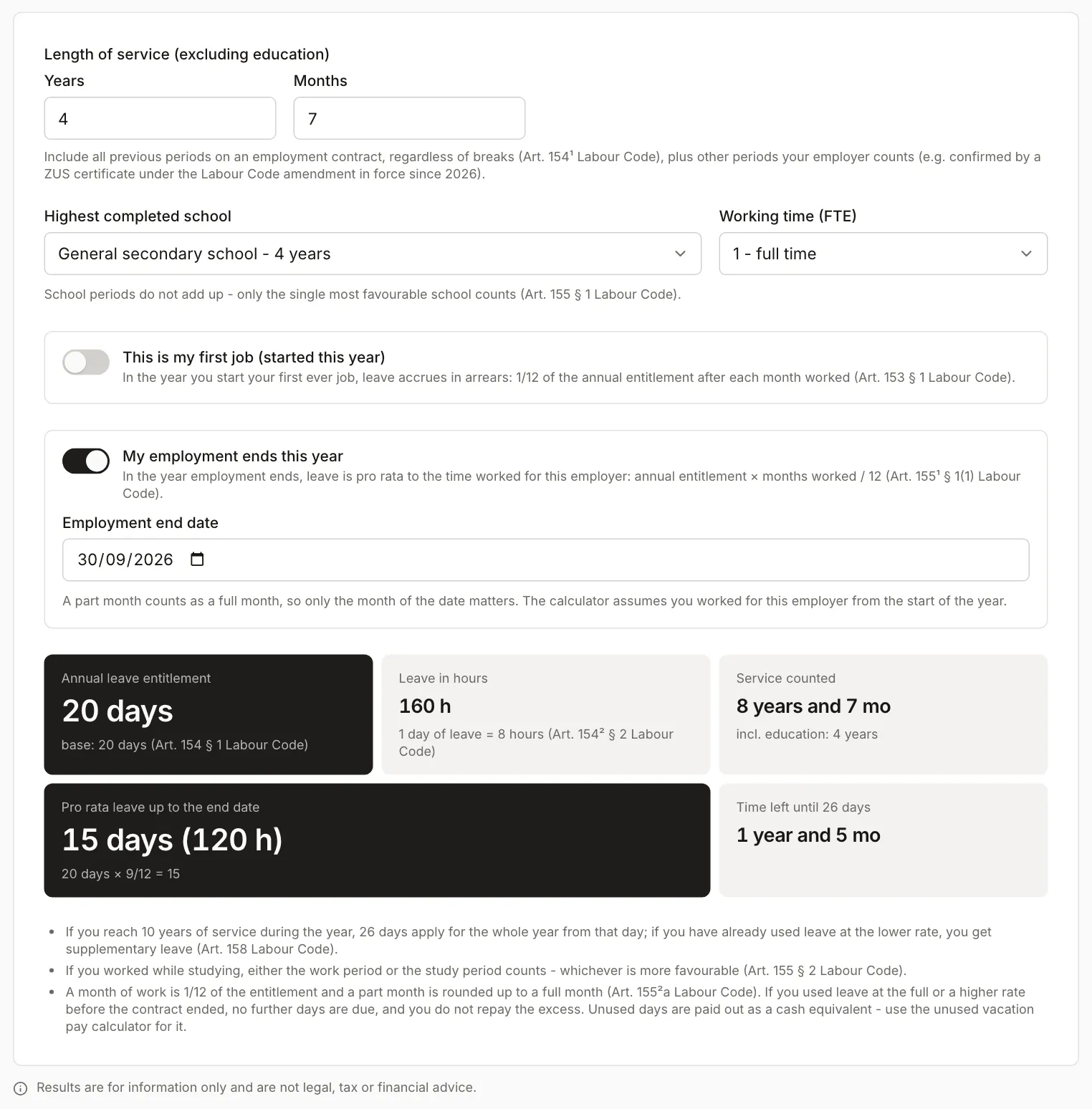
Had the same employee a university degree, service would be 12 years 7 months and the entitlement 26 days, and the calculator would show 26 × 9/12 = 19.5 days, rounded up to 20. If the employee goes straight to a new employer, that employer grants leave proportional to the rest of the year (Art. 155¹ § 1 point 2), and the previous employer rounds up the month in which one contract ends and the other starts (Art. 155²ᵃ § 3).
Unused leave: take it or get it paid out
The employer may grant leave during the notice period, and the employee must then take it. Leave granted this way, other than carried-over leave, may not exceed the proportional entitlement under Art. 155¹ (Art. 167¹). Otherwise the employee gets a cash payment in lieu for the unused leave (Art. 171 § 1). The payment is due however the contract ends, including after notice or by mutual agreement. There is one exception: the parties may agree that the leave will be taken with the same employer under a new contract concluded directly after the old one (Art. 171 § 3). Since 27 January 2026 the Code also sets a payment deadline: with the next regular salary payment, or within 10 days of the end of the contract if the salary date falls before it ends (Art. 171 § 4 and 5).
In the example the employee has 15 days of leave for 2026 and takes 10, which leaves 5 days, or 40 hours. If the employer granted those 5 days during notice, there would be no payout. We assume it did not.
How the payment is calculated
The method is set out in the regulation of the Minister of Labour and Social Policy of 8 January 1997. Fixed pay is taken at the level due in the month the right to payment arises. Variable pay (bonuses, commission, overtime) is averaged over the last 3 months, or 12 months for components paid for periods longer than a month. The total is divided by the leave coefficient, which is the number of working days in the year divided by 12. For 2026 the coefficient is 20.92 (251 working days). The result is divided by 8 and multiplied by the number of unused hours.
In the unused leave pay calculator with PLN 7,000, year 2026 and 5 days:
- per day: PLN 7,000 ÷ 20.92 = PLN 334.61,
- per hour: PLN 334.61 ÷ 8 = PLN 41.83,
- for 40 hours: PLN 41.83 × 40 = PLN 1,673.20 gross.
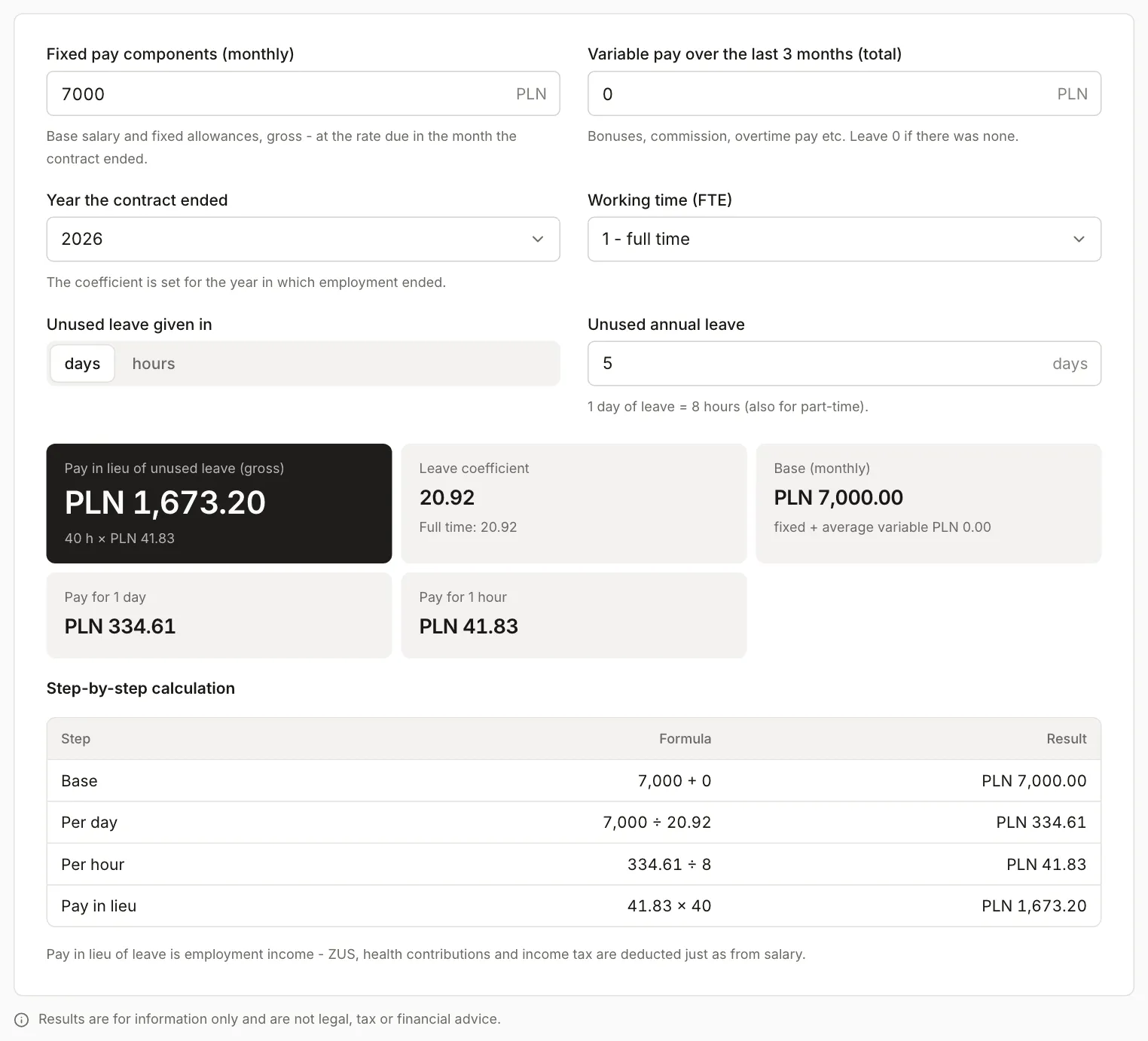
The payment is employment income, so social security and health contributions and income tax advance are deducted from the gross amount as from salary. For part-time work the coefficient is reduced in proportion to the working time, and the calculator has a separate field for it.
When severance is due
Severance under the Act of 13 March 2003 on special rules for terminating employment for reasons not related to employees is due when the employer has at least 20 employees and reasons unrelated to the employee are the only ground for the notice, or for an agreed termination. This covers group redundancies (Art. 1 and 8) and also smaller numbers of dismissals within 30 days (Art. 10(1)). A group redundancy within 30 days starts at 10 people for an employer with fewer than 100 staff, 10% of staff for 100 to 299 employees, and 30 people for 300 or more. There is no severance if the employee resigns, or if the reason lies with the employee.
The amount depends on time with the employer (Art. 8(1)):
| Time with the employer | Severance |
|---|---|
| less than 2 years | 1 month’s pay |
| 2 to 8 years | 2 months’ pay |
| more than 8 years | 3 months’ pay |
Monthly pay is calculated as for the leave payout (Art. 8(3)), so the base is the same PLN 7,000. Severance may not exceed 15 times the minimum wage in force on the day employment ends (Art. 8(4)). The 2026 minimum wage is PLN 4,806, so the cap is PLN 72,090. From 1 January 2027 the minimum wage will be PLN 4,950 (Council of Ministers regulation of 14 September 2026), which makes the cap PLN 74,250 for contracts ending in 2027. In the severance calculator you choose the year the contract ends, 2026 or 2027, and the cap follows from it.
On the day the contract ends (30 September 2026) our employee has 4 years 7 months with the employer, which falls in the 2 to 8 year band. The severance pay calculator with PLN 7,000, 4 years 7 months and the year 2026 shows twice the monthly pay: PLN 14,000 gross, below the cap. Severance is separate from compensation for a shortened notice period and from the leave payout. For determining service the Act refers only to Art. 36 § 1¹ KP (a previous employer in a business transfer). This guide does not settle whether self-employment or civil-law periods under Art. 302¹ count towards severance, so in that case ask HR or a lawyer.
Mutual agreement, dismissal without notice and protected employees
- A mutual agreement (Art. 30 § 1 point 1) lets the contract end on any day, but what happens to leave and severance should be written into the agreement. The leave payout is due however the contract ends, and severance under the Act also applies after an agreed termination when the reason is unrelated to the employee (Art. 1(1) and Art. 10(1)).
- Dismissal without notice for the employee’s fault (Art. 52) has no notice period and must happen within a month of the employer learning of the circumstance. The employer still pays out unused leave, but there is no severance under the Act because the reason relates to the employee.
- The employer may not give notice, among others, to an employee within 4 years of retirement age (Art. 39), during leave or other excused absence (Art. 41), or during pregnancy and parental leaves (Art. 177). Exceptions, such as the employer’s bankruptcy or liquidation (Art. 41¹), are set out in the provisions themselves.
What the calculators do not settle
- The notice period calculator does not check protection from dismissal and does not know your contract: for positions with financial responsibility for property the parties may agree on longer periods (Art. 36 § 5).
- The leave calculator works out the proportional leave from the month the contract ends and assumes the employee worked for this employer from the start of the year. You work out carried-over leave, days already taken and leave with a new employer yourself.
- The leave payout calculator takes fixed pay plus a total of variable components over 3 months. For other variable pay, ask HR.
- Results are for information only. In a dispute with your employer, consult a lawyer or PIP.
Sources (checked October 2026)
- Labour Code, consolidated text, Journal of Laws 2026 item 1245: Art. 30, 34, 36-37, 39, 41, 52, 152-155³, 167¹, 171, 177, 302¹.
- Act of 13 March 2003 on special rules for terminating employment for reasons not related to employees, consolidated text, Journal of Laws 2026 item 1195: Art. 1, 8, 10.
- Regulation of the Minister of Labour and Social Policy of 8 January 1997 on leave, holiday pay and pay in lieu of leave, Journal of Laws no. 2, item 14, as amended by Journal of Laws 2003 no. 230 item 2290 (calculation of the payment and coefficient) and Journal of Laws 2009 no. 174 item 1353 (coefficient for part-time work).
- Act of 26 September 2025 amending the Labour Code, Journal of Laws 2025 item 1423: counting civil-law contracts, self-employment and other periods as employment, with entry-into-force dates, documentation deadlines and transitional rules (Art. 5-9).
- Act of 4 December 2025 amending the Labour Code and the Company Social Benefits Fund Act, Journal of Laws 2026 item 25: payment deadline for the leave payout from 27 January 2026.
- Minimum wage: Council of Ministers regulation of 11 September 2025, Journal of Laws 2025 item 1242 (2026: PLN 4,806) and regulation of 14 September 2026, Journal of Laws 2026 item 1213 (2027: PLN 4,950).