Finance
Polish treasury bonds vs savings account: compare returns after Belka tax and inflation
A savings account quotes one rate. Inflation-linked bonds quote a rate for the first year only and a formula for the rest. This guide shows how to turn both into an amount after Belka tax and a real value after inflation, which assumptions move the result most, and what IKE and IKZE change. It does not recommend a product.
- HNarzędzia editorial team
- Published:
A Polish bank advertises “4% a year”. The Ministry of Finance advertises “4.75% in the first year, then inflation plus 1.5 percentage points”. These two offers cannot be compared directly, because each describes something different: one a flat rate, the other a first-year rate plus a rule for later years. On top of that come Belka tax, compounding and what the money will buy after inflation. This guide works through PLN 10,000 over 4 years in the treasury bonds calculator and the term deposit calculator. The bond offer and the rules were checked in October 2026, and the sources are listed at the end.
Three numbers instead of one interest rate
Before you set two options side by side, work out the same three figures for each:
- The gross amount at the end. It depends on the rate, how often interest is added to the balance (compounding) and the term.
- The net amount, after Belka tax. This is the 19% tax on savings interest and similar capital income in Poland, withheld automatically when interest on a deposit or a bond is paid out (Article 30a(1)(2), (2a) and (3) of the Personal Income Tax Act, “PIT Act”).
- The real value: the net amount divided by the rise in prices over the same period. It tells you how much you can buy with the money compared with the day you paid it in.
Only the third number answers whether your money actually grew. With 3.5% inflation a year, a 4% deposit after Belka tax loses ground. In the compound interest calculator, PLN 10,000 deposited for 4 years ends at PLN 11,360.36 after tax, but in today’s prices that is PLN 9,899.89.
Fixed-rate and inflation-linked bonds
Polish retail treasury bonds differ in where the interest rate comes from. The Ministry describes each series in its issue letter (list emisyjny).
| Type | Interest rate | Example (October 2026 offer) |
|---|---|---|
| Fixed rate | Same rate for the whole term | TOS, 3 years: 4.40% a year, compounded yearly, interest paid at redemption |
| Floating, tied to the NBP rate | National Bank of Poland reference rate plus a margin, interest paid monthly | ROR (1 year) and DOR (2 years) |
| Inflation-linked | Fixed first year, then inflation plus a margin | COI, 4 years: 4.75%, then inflation plus 1.50 pp, interest paid out every year. EDO, 10 years: 5.35%, then inflation plus 2.00 pp, interest added to the balance every year |
For inflation-linked bonds the rate from year 2 is inflation plus the margin. Inflation here means the consumer price index published by GUS (Statistics Poland) in the month before the interest period starts; if it is negative, zero is used (issue letter COI1030, point 16 and annex 1). You learn the year-2 rate only just before it starts, and it does not change during that year. COI and EDO differ in what happens to the interest: COI pays it out every year and earns nothing on it afterwards, while EDO adds it to the principal and pays everything at redemption.
A fixed-rate bond tells you the nominal amount you will get. An inflation-linked bond tells you the margin above inflation in later years, but not the amount. To compare it with a deposit you therefore have to assume inflation and try several values.
Example: PLN 10,000 over 4 years
Bonds: series COI1030, on sale from 1 to 31 October 2026. One bond costs PLN 100, so PLN 10,000 buys 100 bonds. Deposit: 4% a year, an assumption of ours, since bank offers change daily. Inflation: 3.5% a year throughout. That value sits within the 2026 GUS readings: from 2.1% in January to 3.4% in August, with the flash estimate for September at 4.0%.
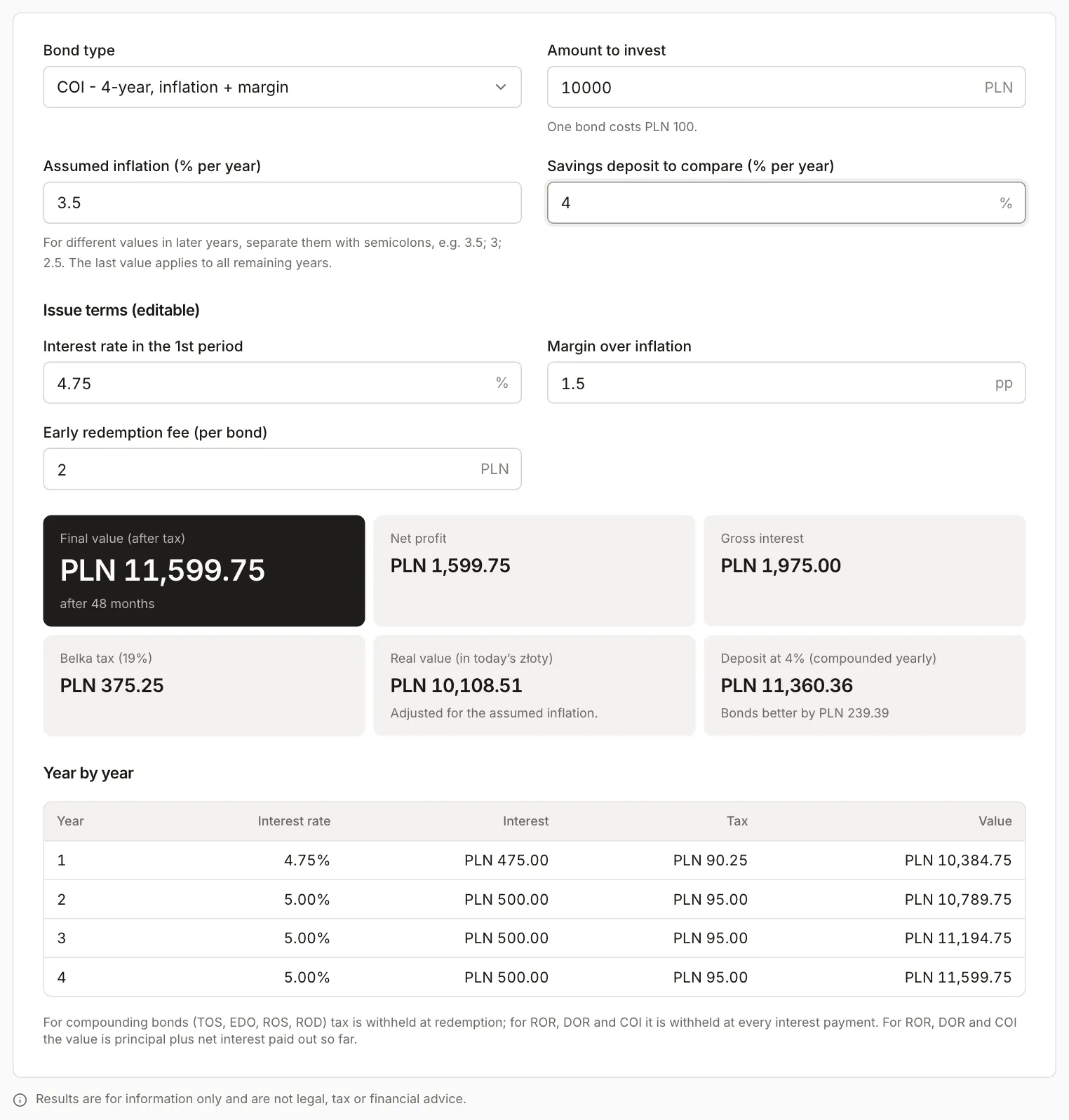
The calculators give:
| Gross interest | Belka tax | Amount after 4 years | Real value at 3.5% inflation | |
|---|---|---|---|---|
| COI, held to maturity | PLN 1,975.00 | PLN 375.25 | PLN 11,599.75 | PLN 10,108.51 |
| Deposit at 4%, compounded yearly | PLN 1,679.45 | PLN 319.09 | PLN 11,360.36 | PLN 9,899.89 |
In this scenario COI ends PLN 239.39 ahead of the deposit, and after inflation your capital is about 1.1% above where it started. The deposit loses about 1% in real terms. The result depends on the assumptions, so the next sections change them one at a time.
Two notes on the table. COI pays interest every year (PLN 475 in year 1, then PLN 500, both before tax), and the calculator does not add it to later investments: it sums it with the principal at the end. If you spend it or invest it elsewhere, the result changes. Also, in the bond calculator the year-2 rate is your assumed inflation plus the margin, so 3.5% + 1.5% = 5.00%. In reality it depends on the GUS reading published just before that year starts.
Compounding and how a deposit counts interest
“4% a year” can mean three different things. For a 4-year deposit of PLN 10,000 at 4%, the deposit calculator shows:
| Compounding | Gross interest | Tax | Amount after 4 years | Net yearly return |
|---|---|---|---|---|
| At maturity | PLN 1,600.00 | PLN 304.00 | PLN 11,296.00 | 3.24% |
| Yearly | PLN 1,679.45 | PLN 319.09 | PLN 11,360.36 | 3.40% |
| Monthly | PLN 1,705.85 | PLN 324.10 | PLN 11,381.75 | 3.45% |
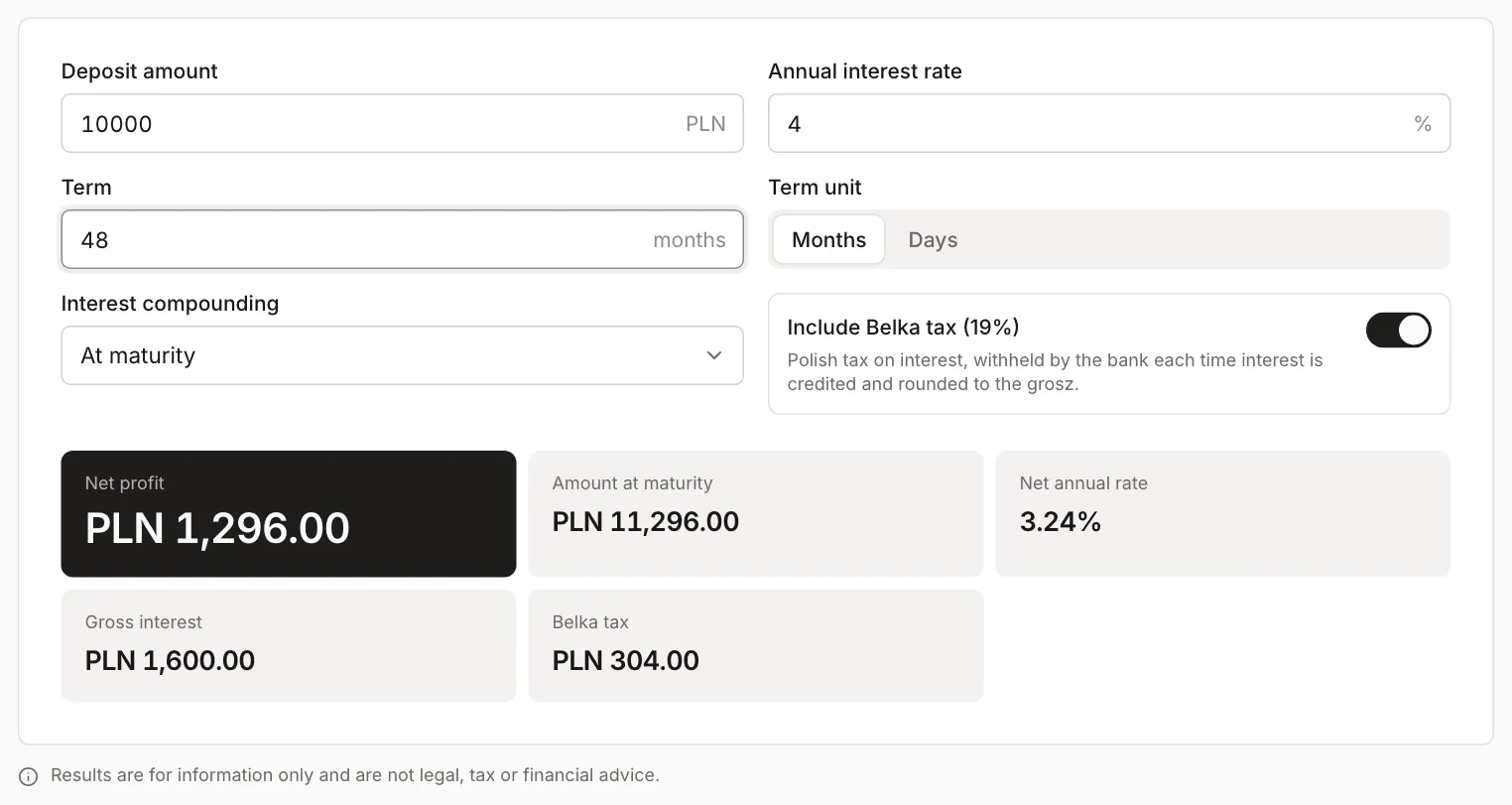
The gap between the two extremes is PLN 85.75 at the same rate. Ask the bank whether interest is credited to the account and earns interest itself or is paid out at the end, and whether the deposit is renewed after a year on new terms. The deposit calculator assumes tax is calculated at each compounding and rounded to the grosz. The compound interest calculator also lets you enter average inflation and shows the real value straight away.
How inflation changes the result
A deposit rate is known in advance, while the rate on inflation-linked bonds follows inflation. That is why the comparison shifts with the assumption. The same COI offer and the same 4% deposit (compounded yearly), PLN 10,000 for 4 years:
| Inflation per year | COI after 4 years | COI in real terms | Deposit after 4 years | Deposit in real terms |
|---|---|---|---|---|
| 2.0% | PLN 11,235.25 | PLN 10,379.63 | PLN 11,360.36 | PLN 10,495.21 |
| 3.5% | PLN 11,599.75 | PLN 10,108.51 | PLN 11,360.36 | PLN 9,899.89 |
| 5.0% | PLN 11,964.25 | PLN 9,843.02 | PLN 11,360.36 | PLN 9,346.19 |
At 2% inflation the 4% deposit wins both in nominal and real terms. The break-even for this pair is around 2.5% (at 2.5% COI gives PLN 11,356.75, at 2.6% already PLN 11,381.05). At 5% COI pays more than PLN 600 extra, but you still end below the PLN 10,000 you put in, in real terms, because Belka tax is charged on nominal interest, including the part inflation has eaten.
Nobody knows inflation two years ahead, so enter several values in the bond calculator. You can give different values for later years separated by semicolons, for example 3.5; 3; 2.5. To see how fast money loses value, use the inflation calculator, which works on annual GUS figures: PLN 10,000 from 2021 equals PLN 13,678.26 in 2025 prices, so prices rose by 36.78% in that time.
GUS publishes both an annual average and a monthly figure compared with the same month a year earlier, and the two can differ a lot: the 2025 average was 3.6%, while in December 2025 inflation year on year was 2.4%. To get a real value, divide the after-tax amount by (1 + inflation) raised to the number of years, so you can check other assumptions yourself.
Fixed-rate bonds: a certain amount, an uncertain real value
TOS pays a fixed 4.40% for 3 years, with interest added to the balance every year. For PLN 10,000 the calculator gives PLN 11,116.99 after 3 years and tax (gross interest PLN 1,379.00, tax PLN 262.01). A 4% deposit compounded yearly gives PLN 11,003.84 over the same period. TOS comes out PLN 113.15 ahead. The amount does not depend on inflation, but the real value does (the amount divided by (1 + inflation) to the power of 3):
| Inflation per year | TOS after 3 years | TOS in real terms |
|---|---|---|
| 2.0% | PLN 11,116.99 | PLN 10,475.79 |
| 3.5% | PLN 11,116.99 | PLN 10,026.89 |
| 5.0% | PLN 11,116.99 | PLN 9,603.27 |
With a fixed rate, inflation affects only the real value. With an indexed rate, the rate follows inflation with a delay of one year and the margin is known up front. The inflation field in the bond calculator is available for every bond, so you can check these values for TOS as well.
Redeeming bonds early
You can redeem bonds 7 days after purchase, up to 20 days before maturity. The money arrives after 5 working days. The payout is reduced by a fee per bond (PLN 100 nominal): for bonds bought from 1 September 2024 it is PLN 1.00 for TOS, PLN 2.00 for COI and PLN 3.00 for EDO (series pages). The details depend on the type. For TOS and EDO the fee never exceeds the accrued interest, so the principal is safe. For COI the fee is also capped at the interest in the first year, but from the second interest period it is taken in full from the redemption amount (issue letter COI1030, point 26).
A few changes in the bond calculator show what that costs (PLN 10,000, 3.5% inflation):
| Scenario | Fee | Amount after tax |
|---|---|---|
| EDO after 48 months | PLN 300.00 | PLN 11,676.70 |
| COI after 18 months | PLN 200.00 | PLN 10,387.25 |
| EDO after 12 months | PLN 300.00 | PLN 10,190.35 |
EDO redeemed after 4 years still returns PLN 11,676.70, more than COI held to maturity, despite the PLN 300 fee. This comes from the higher margin and from EDO interest compounding. After one year, however, the profit after fee and tax is only PLN 190.35, more than PLN 130 less than on a 4% deposit (PLN 10,324.00). If you might need the money before the end date, build that exit into the comparison. A deposit has its own rules for breaking it early, set in the contract with the bank. The deposit calculator does not count penalties, so ask the bank. There is no fee on withdrawals from IKE and IKZE, as explained below.
IKE and IKZE: limits and tax
IKE (Individual Retirement Account) and IKZE (Individual Retirement Security Account) are Polish accounts with lower or no tax on gains. The issue letter for bonds bought through PKO BP says they can be held in IKE and IKZE.
| IKE | IKZE | IKZE, self-employed | |
|---|---|---|---|
| 2026 contribution limit | PLN 28,260 | PLN 11,304 | PLN 16,956 |
| Basis | 3 times the projected average wage | 1.2 times | 1.8 times |
| Tax on gains | exempt if you meet the withdrawal conditions | contributions are deducted from income, withdrawals taxed at 10% | same as IKZE |
| Withdrawal | from age 60 (or from 55 if you have pension entitlements), with contributions in at least 5 calendar years or more than half of the contributions made at least 5 years earlier | from age 65, with contributions in at least 5 calendar years | same as IKZE |
The limits come from announcements by the Minister of Family, Labour and Social Policy: IKE PLN 28,260 (Monitor Polski 2025 item 1202), IKZE PLN 11,304 and PLN 16,956 (Monitor Polski 2025 item 1156). They are 3, 1.2 and 1.8 times PLN 9,420, the projected average monthly wage for 2026. The IKE and IKZE calculator shows the same amounts.
The IKZE tax relief is your contribution multiplied by your tax rate, because contributions are deducted from income (Article 26(1)(2b) of the PIT Act). For a contribution of PLN 11,304 that gives PLN 1,356.48 at a 12% rate and PLN 3,617.28 at 32%. Withdrawals from IKZE are taxed at a flat 10% (Article 30(1)(14) of the PIT Act).
An example from the IKE and IKZE calculator: PLN 10,000 a year for 10 years, a 4.5% return and a 12% tax rate. IKE is worth PLN 128,411.79 after 10 years. A regular account with Belka tax paid on sale leaves PLN 123,013.55, because PLN 5,398.24 goes to the tax office. IKZE gives PLN 127,570.61 after the 10% tax, including PIT refunds (PLN 12,000, not reinvested). This model assumes a constant return and no account fees.
The price is access to your money. Money returned from IKE before the withdrawal conditions are met is taxed at 19% on the gain (Article 30a(1)(10) of the PIT Act), and for IKZE you should check the rules in the IKE and IKZE Act. Both accounts therefore suit a retirement goal, not a 4-year one.
On a withdrawal or a transfer withdrawal from IKE or IKZE, no early redemption fee is charged on bonds (COI1030, point 26, items 5 and 6). The “IKE or IKZE” switch in the bond calculator applies this waiver and removes Belka tax, but it does not add the 10% on IKZE withdrawals. For COI in IKE the result is PLN 11,975.00, since all the interest (PLN 1,975.00) stays whole. EDO for PLN 10,000 redeemed in an IKE after 12 months returns PLN 10,535.00, against PLN 10,190.35 outside an IKE, which loses PLN 300 in fees and PLN 44.65 in tax. The issue letter names only a withdrawal and a transfer withdrawal, so if you take money out of an IKE before the withdrawal conditions are met (a refund), ask the brokerage whether the fee applies.
Comparing two offers step by step
- Fix the horizon. Bonds have a set term (TOS 3 years, COI 4, EDO 10); a deposit can have any term. Compare offers over the same period, or count early redemption.
- Write down your assumptions: the deposit rate, the compounding and inflation. For inflation use at least three values, for example 2%, 3.5% and 5%.
- Calculate the amount after Belka tax for each option. Turn on IKE only if you can leave the money until withdrawal age.
- Convert to real value and check at what inflation the order flips.
- Check the cost of leaving: the early redemption fee on bonds and the rules for breaking the deposit.
Three things change the result most: inflation (for COI and EDO), the deposit rate after renewal and the moment you exit. This guide does not say what to choose. Liquidity, the risk of the institution and how you buy may matter to you too.
What the calculators do not show
- The year-2 rate of inflation-linked bonds is your assumed inflation plus the margin. In reality it depends on the GUS reading published just before the period starts.
- Annual COI interest is not reinvested.
- Offers change every month. The first-period rate, margins and fees in the bond calculator come from the issue letters for October 2026; check the current ones at obligacjeskarbowe.pl before buying.
- The deposit rate is assumed, not taken from a particular bank.
- The result is indicative and is not financial or tax advice.
Sources (as of October 2026)
- Treasury bond offer: series pages for COI1030, EDO1036 and TOS1029; issue letter no. 98/2026 of the Minister of Finance and Economy of 21 September 2026 (COI1030). The pages are in Polish.
- GUS (Statistics Poland), consumer price indices (monthly and annual data) and the flash estimate for September 2026, published on 30 September 2026.
- Personal Income Tax Act, consolidated text, Journal of Laws 2026 item 592: Articles 26(1)(2b), 30(1)(14) and 30a(1)(2), (2a) and (3). In Polish.
- Act on Individual Retirement Accounts and Individual Retirement Security Accounts, consolidated text, Journal of Laws 2026 item 91: Articles 13, 13a, 34 and 34a. In Polish.
- Announcements of the Minister of Family, Labour and Social Policy: IKE limit for 2026, Monitor Polski 2025 item 1202 and IKZE limits for 2026, Monitor Polski 2025 item 1156.