Finance
Mortgage in Poland: equal or decreasing instalments, overpayments and how much a bank will lend
On a PLN 500,000 mortgage over 25 years at 6%, an equal instalment is PLN 3,221.51 for the whole term, while a decreasing one starts at PLN 4,166.67 and ends at PLN 1,674.00. The interest differs by PLN 90,201.65. This guide shows where that gap comes from, what an overpayment does in each case and how to estimate how much a Polish bank may lend.
- HNarzędzia editorial team
- Published:
A Polish mortgage is repaid in monthly instalments (raty), and the bank offers two schedules. With equal instalments, also called annuity instalments (raty równe), you pay the same amount every month, so early payments are mostly interest. With decreasing instalments (raty malejące) the principal part is the same every month, and the interest falls with the balance, so the payment shrinks. We run both in the mortgage calculator Poland, then test an overpayment in the loan overpayment calculator and the limit on the loan size in the borrowing capacity calculator Poland. In the tools the two options are called “Equal (annuity)” and “Decreasing”.
Assumptions of the example
A loan of PLN 500,000 over 25 years (300 instalments) at 6% a year, with no arrangement fee or other charges. The 6% is an assumption for the example, not a bank offer. For a variable rate you enter the reference rate plus the bank’s margin from your offer. The calculator assumes the rate stays the same until the end, and the section on WIBOR and WIRON below explains what that means for a variable rate.
Equal and decreasing instalments in numbers
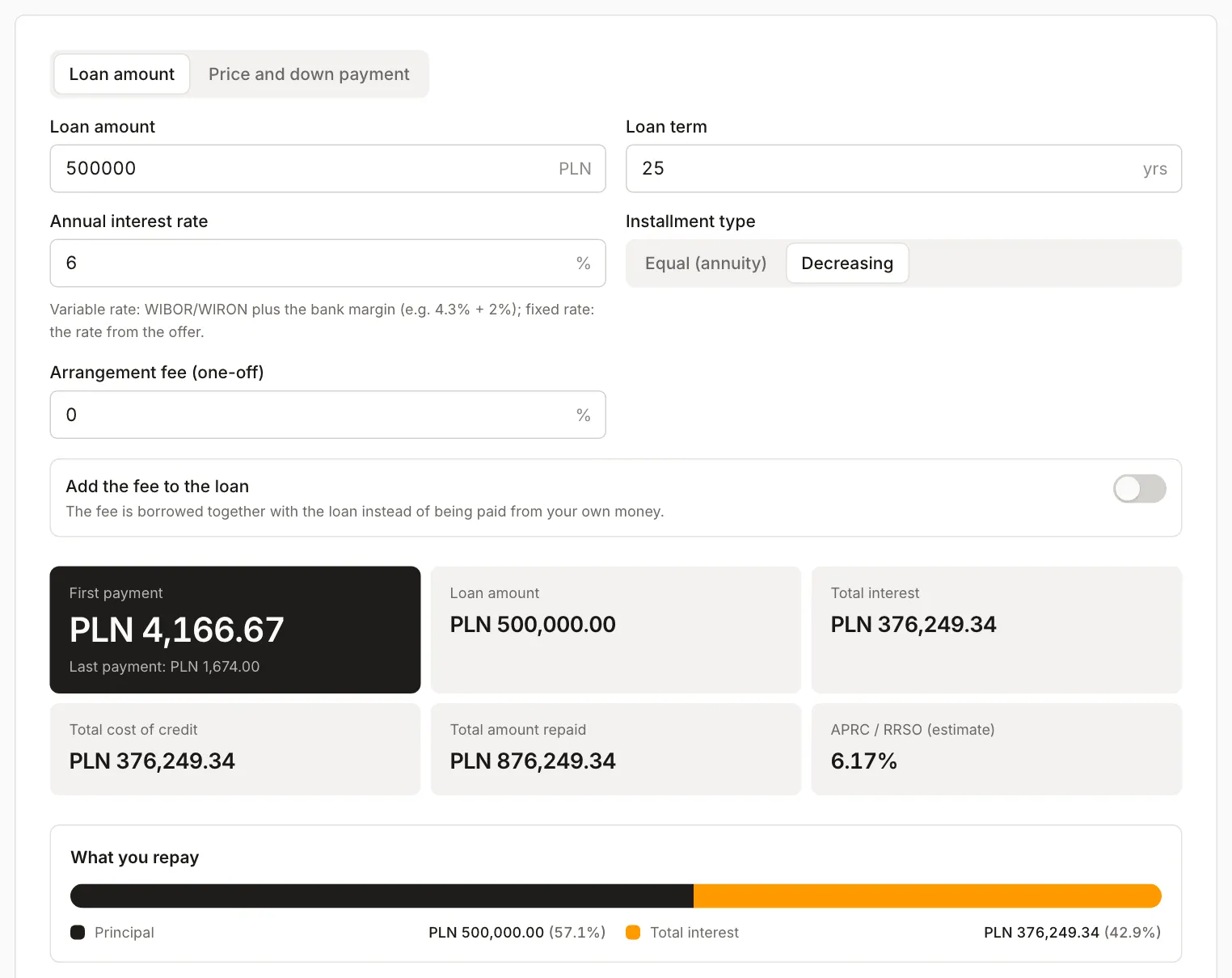
| Equal | Decreasing | |
|---|---|---|
| First instalment | PLN 3,221.51 | PLN 4,166.67 |
| Last instalment | PLN 3,219.50 | PLN 1,674.00 |
| Total interest | PLN 466,450.99 | PLN 376,249.34 |
| Total repaid | PLN 966,450.99 | PLN 876,249.34 |
| Balance after 3 years (36 instalments) | PLN 471,618.62 | PLN 439,999.88 |
| Paid in the first 3 years | PLN 115,974.36 | PLN 144,750.12 |
Decreasing instalments cost PLN 90,201.65 less in interest, but the first payment is PLN 945.16 higher. Over the first three years you pay about PLN 28,800 more, and after three years about PLN 31,600 less is left to repay. The decreasing instalment drops below the equal one (PLN 3,221.51) from instalment 115, in the tenth year. Instalment 120 is PLN 3,175.00 and instalment 150 is PLN 2,925.00. The lower interest comes from repaying principal faster, so interest accrues on a smaller balance.
The same loan at other rates:
| Rate | Equal instalment | First decreasing instalment | Interest: equal | Interest: decreasing | Difference |
|---|---|---|---|---|---|
| 5% | PLN 2,922.95 | PLN 3,750.00 | PLN 376,884.89 | PLN 313,541.05 | PLN 63,343.84 |
| 6% | PLN 3,221.51 | PLN 4,166.67 | PLN 466,450.99 | PLN 376,249.34 | PLN 90,201.65 |
| 7% | PLN 3,533.90 | PLN 4,583.34 | PLN 560,166.67 | PLN 438,957.47 | PLN 121,209.20 |
A decreasing schedule always starts higher. The interest totals do not account for what you do with the money that equal instalments leave in your budget in the early years. It makes sense to start with whether you can carry the highest payment in your monthly spending, and only then compare total interest.
How much will a bank lend: borrowing capacity
A bank checks whether the instalment fits your budget. The capacity calculator estimates a loan for both equal and decreasing instalments. With decreasing ones the first, highest instalment sets the limit, so the same income supports a smaller loan. In the example below that is PLN 432,000.00 instead of PLN 558,848.56.
What the calculator does
The tool estimates the maximum loan in three steps:
- The maximum instalment is the smaller of two values: net income times the DSTI threshold minus existing commitments, or income minus living costs minus commitments. DSTI (debt service to income) is the share of your net income that goes on all loan instalments. With decreasing instalments this is the first, highest instalment.
- The test rate is your interest rate plus the interest rate buffer, a margin for rate rises. The size of the buffer depends on the rate type (variable, fixed for a period or fixed for the whole loan), as the next section explains.
- The loan is the amount at which the instalment (equal, or the first decreasing one) does not exceed the maximum instalment at the test rate over your term.
Default assumptions: DSTI of 40% for net income up to PLN 6,750 per borrower and 50% above it (you can change the amount, because it is the calculator’s assumption), living costs of PLN 2,000 for the first person and PLN 1,200 for each further one, 3% of a credit card limit counted as a monthly burden, employment income counted in full, B2B (sole trader) income at 85% and umowa zlecenie (civil-law contract) income at 80%. A mortgage can run for at most 35 years. If you need to turn gross pay into net, see the guide to gross to net salary in Poland.
Example: single borrower on an employment contract
Inputs: PLN 9,000 net a month, employment contract, no other instalments or cards, 25-year loan, 6% interest (reference rate 4% plus a 2% margin), variable rate, NBP reference rate 3.75%. In the rows with a fixed rate the interest rate is also 6%.
| Scenario | Maximum instalment | Maximum loan |
|---|---|---|
| Baseline: equal instalments, variable rate (2.5 pp buffer) | PLN 4,500.00 | PLN 558,848.56 |
| Decreasing instalments (first instalment) | PLN 4,500.00 | PLN 432,000.00 |
| Equal, rate fixed for 10 years (1.875 pp buffer) | PLN 4,500.00 | PLN 589,349.30 |
| Equal, rate fixed for the whole loan (no buffer) | PLN 4,500.00 | PLN 698,430.89 |
| Equal, credit card with a PLN 10,000 limit | PLN 4,200.00 | PLN 521,591.99 |
| Equal, another loan instalment of PLN 600 a month | PLN 3,900.00 | PLN 484,335.42 |
| Equal, PLN 9,000 net from a sole-trader business (B2B) | PLN 3,825.00 | PLN 475,021.28 |
At PLN 558,848.56 the equal instalment is PLN 3,600.67, which is 40% of income. With decreasing instalments the same income supports PLN 432,000.00: the first instalment is then PLN 3,600.00 and the last PLN 1,447.20. To borrow PLN 500,000 you need about PLN 8,052 net with equal instalments and about PLN 10,417 with decreasing ones (the calculator then shows PLN 500,016.00). Ask your bank how it calculates capacity for decreasing instalments.
What the KNF Recommendation S says
KNF is the Polish Financial Supervision Authority. Its Recommendation S covers mortgage lending. According to the consolidated text after resolution 242/2023 of 19 June 2023, a bank tests affordability at a rate raised by an interest rate buffer. The buffer should be at least:
- for a variable rate: the larger of 5 pp minus the NBP reference rate and 2.5 pp, plus a σ add-on of 0 or 1.5 pp. The 1.5 pp add-on applies when the standard deviation of the NBP rate over the last 100 working days is at least 0.5 pp and the latest rate is above the average for that period. With an NBP rate of 2.5% or more the buffer is 2.5 pp,
- for a rate fixed for a period (at least 5 years): 2.5 pp times (T - x) / (T - 60), where T is the loan term and x the fixed period, both in months. On a 25-year loan the buffer is 2.5 pp with a 5-year fixed period and 1.875 pp with 10 years,
- for a rate fixed for the whole loan: no buffer.
DSTI is a caution level in the recommendation: a bank should pay particular attention when it exceeds 40% (income not above the average wage in the region of residence) or 50% (other clients). It may go above these levels if it knowingly accepts the higher risk. The recommendation also says a bank should not grant a loan longer than 35 years, and for terms over 25 years it should assess affordability over 25 years.
The calculator applies these buffer formulas and treats the DSTI levels as an upper bound on the instalment, to keep the result cautious. The PLN 6,750 net figure for the average wage is its own assumption: the recommendation gives no amount and ties the level to the region of residence. The calculator uses the number of years you enter for the term. Banks also apply their own rules: living costs, income stability, credit history at BIK (the Polish credit bureau), age and down payment.
Overpayment: shorter term or lower payment
After an overpayment the bank usually asks whether to shorten the loan or lower the instalment. In the example you pay PLN 20,000 as a one-off after 3 years (36 instalments). There are 264 instalments left, the rate is still 6% and there is no early repayment fee.
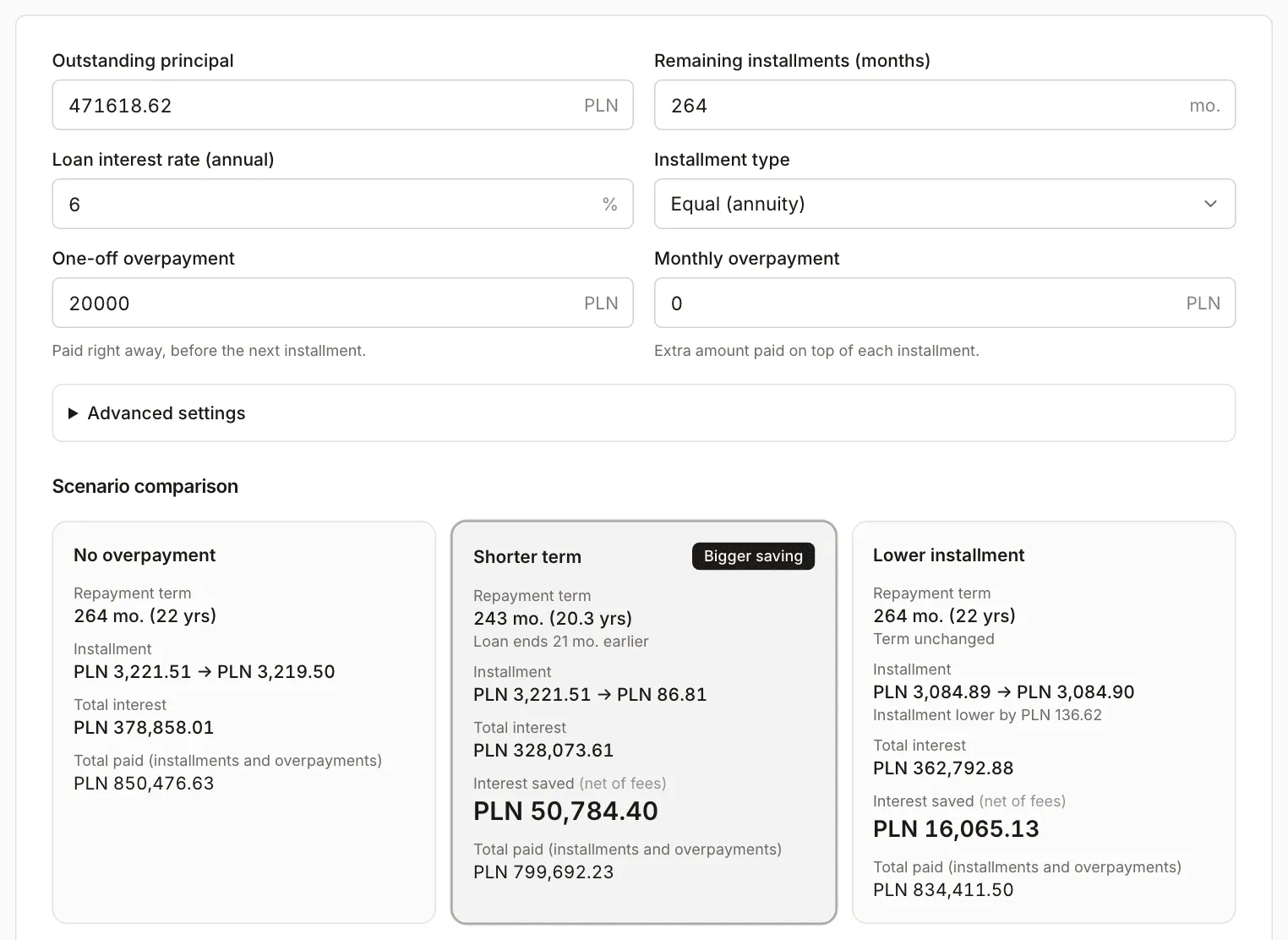
| Equal (balance PLN 471,618.62) | Decreasing (balance PLN 439,999.88) | |
|---|---|---|
| Interest to the end, no overpayment | PLN 378,858.01 | PLN 291,499.34 |
| Shorter term: instalments | 243 (21 fewer) | 252 (12 fewer) |
| Shorter term: instalment | PLN 3,221.51, last PLN 86.81 | PLN 3,766.67 (first), PLN 1,674.04 (last) |
| Shorter term: interest saved | PLN 50,784.40 | PLN 25,849.96 |
| Lower instalment: new payment | PLN 3,084.89 (PLN 136.62 lower) | PLN 3,690.91 (first), PLN 175.76 lower |
| Lower instalment: interest saved | PLN 16,065.13 | PLN 13,249.58 |
With both types of instalment the shorter term saves more: PLN 50,784.40 against PLN 16,065.13 with equal instalments, and PLN 25,849.96 against PLN 13,249.58 with decreasing ones. For PLN 20,000 you then end the loan 21 months early (equal) or 12 months early (decreasing). With a lower instalment the term stays the same and the monthly payment falls by PLN 136.62 or PLN 175.76. You save less interest but gain room in the budget if your income drops or the payment rises on a variable rate.
Do not compare the two columns with each other, because the balances differ: with decreasing instalments less is left to repay after three years. Draw conclusions within one column.
Before you overpay, check your loan agreement for an early repayment fee and for the amount from which an overpayment counts towards principal. In the calculator’s advanced settings you can enter such a fee as a percentage of the overpaid amount, and the result shows the saving after the fee. Set the saving against other uses of the money, for example a deposit, and keep a reserve for unexpected costs.
Variable rate: WIBOR and WIRON
The interest rate on a variable-rate mortgage is a reference rate plus the bank’s margin. The reference rate is WIBOR or WIRON, depending on your contract: both are Polish interbank rates published by GPW Benchmark. The rate moves, and your instalment moves with it. On 9 October 2026 the WIBOR fixing was 3.88% for 3 months and 3.94% for 6 months, and WIRON on 8 October 2026 was 3.290%. Your contract states which rate and which tenor applies. The bank sets the margin, so this guide does not assume one.
To see how sensitive the instalment is, enter a few rates into the calculator. In our example an equal instalment is PLN 2,922.95 at 5%, PLN 3,221.51 at 6% and PLN 3,533.90 at 7%. One percentage point more raises the payment by PLN 312.39, and one point less lowers it by PLN 298.56. The calculator assumes a constant rate, so with a variable rate the result applies only to the rate you enter.
Where to start
- Estimate your capacity for your rate type and check whether equal instalments fit, then decreasing ones.
- In the mortgage calculator compare both types for your amount, term and rate. Look at the first and last instalment, total interest and the APRC (RRSO in Polish, the annual percentage rate of charge).
- For an overpayment, enter the balance and the number of remaining instalments from the bank’s schedule, not the original loan amount.
What the calculators do not cover
- Insurance, valuation costs, other bank fees and notary costs. The mortgage calculator includes interest and a one-off arrangement fee.
- Changes in the interest rate during repayment.
- The bank’s own assessment: credit history at BIK, length of employment, age, down payment and its own living-cost tables. The capacity result is an estimate, and the real amount may be lower or higher.
The results are for information only and are not financial or legal advice. You decide on the type of instalments, an overpayment and the loan size together with the bank, ideally using the schedule from its offer.
Sources
- KNF Recommendation S, consolidated text after resolution 242/2023 of 19 June 2023 (in Polish): interest rate buffer, DSTI and loan term. Checked in October 2026.
- National Bank of Poland: base interest rates: the reference rate has been 3.75% since 5 March 2026. Checked on 11 October 2026.
- GPW Benchmark: WIBOR rates (9 October 2026) and WIRON (8 October 2026), checked on 11 October 2026.